When it comes to heat exchangers, the term “compact design” does not only refer to a product that is physically small in size. Compact design means that high heat transfer capacity can be achieved with minimal volume and area usage. In other words, the concept of compactness is based on the ability of a heat exchanger to provide the same or even higher performance than larger and bulkier systems within a much smaller body.
Soldered heat exchangers stand out at this point. Thanks to their special plate structure and production technology, they offer a much higher heat transfer surface/volume ratio compared to traditional tubular or gasketed systems. This allows for solutions that occupy less space, are lighter, and can be more easily integrated to meet the same heat load. One of the most significant advantages of compact design is that it simplifies system design in mechanical rooms, inside machines, or in applications with space constraints. Particularly in modern facilities and OEM productions, having equipment that takes up less space accelerates the assembly process and provides flexibility in system architecture. Soldered heat exchangers are among the products that can directly respond to these requirements.
Moreover, the compact structure is not just a limited advantage in physical dimensions. Technical gains such as shorter flow paths, lower heat losses, and faster heat transfer are also a natural result of compact design. This allows systems to reach the desired temperature in a shorter time, energy to be used more efficiently, and overall operational performance to increase. In summary, compact design refers to an engineering approach that offers many advantages such as high performance, space savings, efficient heat transfer, and compatibility with modern systems. Soldered heat exchangers are one of the most successful examples of this approach in industrial applications.
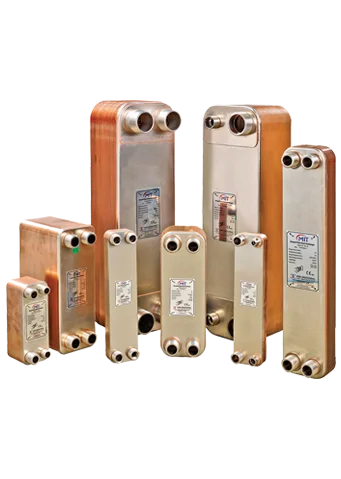
The Effect of Plate Structure on Compactness
One of the fundamental reasons why soldered heat exchangers have a compact design is that they operate based on the principle of plate structure. This structure enables heat transfer to occur with high efficiency within very narrow spaces. While heat transfer in traditional tubular exchangers is provided through the surfaces of the pipes, in soldered exchangers, this task is undertaken by thin metal plates. Thanks to the plate structure, the heat transfer surface can be increased by folding within the same volume. Plates with thin and special geometries are stacked on top of each other to create numerous parallel channels for the fluids. These channels do not require large volumes as in tubular systems. On the contrary, they allow for a much larger contact surface to be achieved within a smaller body. This enables an increase in performance despite the physical reduction in the size of the exchanger.
In tubular exchangers, to increase heat transfer capacity, either the number of pipes must be increased or the lengths of the pipes must be extended. This significantly increases both the volume and weight of the device. In plate exchangers, however, capacity increase is mostly achieved through the arrangement and geometry of the plates. This approach allows for compactness and high capacity to be achieved simultaneously. The very close positioning of the plates allows the fluids to flow in a more controlled and directed manner. This structure accelerates heat transfer and prevents unnecessary voids from forming. As a result, soldered heat exchangers can be designed in much smaller sizes compared to tubular exchangers required for the same task. The plate structure also offers a modular engineering approach. By using different plate patterns and arrangements, exchanger sizes can respond to different capacity and application needs without increasing in size. This makes soldered heat exchangers compact yet flexible solutions. Thanks to these structural advantages, soldered heat exchangers have become a preferred choice in many applications where compactness is required in today’s industrial facilities and modern machine designs.
High Heat Transfer Surface / Volume Ratio
One of the most critical engineering elements behind the compact design of soldered heat exchangers is their high heat transfer surface / volume ratio. This ratio indicates how much heat transfer surface a heat exchanger can accommodate within a specific volume and is one of the direct determinants of performance. Thanks to the plate structure, soldered heat exchangers create a wide heat transfer surface using very thin metal plates. Since these plates are stacked on top of each other with narrow gaps, the total volume of the exchanger does not increase, while the surface area that the fluids come into contact with is significantly increased. Thus, the same heat load can be met within a much smaller body. In tubular exchangers, the heat transfer surface is limited by the pipe diameter and pipe length. Capacity increase often requires larger diameters or longer pipes. This leads to a physical increase in the size of the device. In soldered heat exchangers, however, the surface area can be increased through the number of plates and plate geometry. This approach allows for high performance to be achieved while keeping the external dimensions of the exchanger to a minimum.
A high surface/volume ratio provides significant advantages not only in terms of compactness but also in terms of increased heat transfer speed. Since fluids flow much closer to the surface of the plates within narrow channels, heat transfer occurs in a shorter time. This contributes to the exchanger's faster response and helps the system reach stable operating conditions in a short time. Additionally, a high heat transfer surface allows for operation with lower temperature differences. This is particularly important in applications where energy efficiency is critical. Since effective heat transfer can be achieved even with small temperature differences, energy losses across the system are reduced.
As a result, soldered heat exchangers offer advantages such as high performance, fast heat transfer, and efficient system design in small sizes thanks to their high heat transfer surface / volume ratio. This feature clearly demonstrates that compact design is not just a physical preference but a conscious engineering result.
The Role of Turbulent Flow and Channel Geometry
Despite the compact structure of brazed heat exchangers, the controlled creation of turbulent flow and special channel geometries play a critical role in providing high performance. The main goal in heat transfer is to increase the contact between the fluid and the heat transfer surface. Turbulent flow ensures that this contact occurs in the most effective way. The plates used in brazed heat exchangers are not flat surfaces. The special patterns and grooves on the plate surfaces prevent the fluid from moving in a straight line, directing the flow and creating turbulence. This turbulence ensures continuous contact of the fluid with the plate surface and minimizes boundary layer formation. As a result, the heat transfer coefficient significantly increases.
Channel geometry is another element that directly supports the compact design of the exchanger. Thanks to the narrow and controlled channels formed between the plates, the fluid moves in a dense and directed manner without spreading into large volumes. This situation provides both high heat transfer efficiency and prevents unnecessary volume increase. Thus, the exchanger can offer high capacity in small sizes. Another advantage of turbulent flow is that the heat transfer performance becomes more homogeneous. Since the fluid is evenly distributed along the plate surface, temperature differences are more balanced. This contributes to effective heat transfer throughout the exchanger and reduces local efficiency losses.
Of course, pressure losses must also be considered when creating turbulence. The plate patterns used in brazed heat exchangers are designed to maintain this balance. The aim is to achieve maximum heat transfer with the lowest possible pressure loss. Thanks to this engineering balance, brazed exchangers do not negatively affect system efficiency despite their compact structure.
In summary, special channel geometries and controlled turbulent flow structure are among the main reasons why brazed heat exchangers can provide high performance in small volumes. This feature shows that the compact design is optimized not only dimensionally but also in terms of fluid mechanics.
Contribution of Vacuum Brazing Technology
One of the most important production stages that enables brazed heat exchangers to have a compact design is vacuum brazing technology. This technology allows the plates to be joined together without the need for gaskets, creating a completely metallurgical bond. The resulting structure is both extremely durable and capable of providing maximum performance in minimum volume. During the vacuum brazing process, the plates and brazing material are exposed to high temperatures in a controlled environment. Thanks to this process carried out under vacuum, oxidation is prevented, and the brazing material is evenly distributed to all contact points between the plates. This creates a structure that provides complete sealing between the plates, functioning as a single piece.
The gasket-free structure is a significant advantage in terms of compact design. In gasketed exchangers, additional gasket grooves, spacers, and connecting elements are required to ensure sealing. These components increase both the external dimensions of the exchanger and the structural complexity. However, exchangers produced by vacuum brazing do not require these extra parts. Thus, the body can be designed in a thinner, simpler, and more compact form. Vacuum brazing also allows the distance between the plates to be kept at a minimum level. Since the plates can be positioned very close together without concerns about sealing, the flow channels can be narrowed. This both increases the effectiveness of the heat transfer surface and reduces the overall volume of the exchanger. This precise manufacturing approach behind the compact design is one of the key features that distinguish brazed heat exchangers from other types.
From a mechanical strength perspective, vacuum brazing technology also offers significant contributions. The metallurgical bond between the plates makes the exchanger more resistant to pressure and temperature changes. This durability is achieved without the need for thick walls or large bodies, thus preserving the compact design.
As a result, vacuum brazing technology is the fundamental production method that enables brazed heat exchangers to offer high strength, sealing, and performance in small sizes. Without this technology, it would not be possible to talk about today's compact brazed exchanger designs.
Advantages of Compact Design in Terms of Pressure and Strength
The compact design of brazed heat exchangers not only saves space but also offers significant advantages in terms of pressure resistance and mechanical strength. Small-volume and integrated structures create a more controlled and safe working environment under high pressure and temperature conditions. In compact design, the flow paths are shorter and more directed. As the distance the fluid travels within the exchanger decreases, pressure fluctuations and mechanical stresses are minimized. This allows the stresses that may occur on the exchanger body to be distributed more homogeneously. As a result, brazed heat exchangers can maintain their structural integrity even at high operating pressures.
The fact that the plates are fixed to each other using the vacuum brazing method is another factor supporting the strength of the compact structure. Since there are no gaps or flexible connections between the plates, the risk of deformation under pressure is reduced. This integrated structure allows the exchanger to behave like a single body against internal pressure and provides safe performance in high-pressure applications.
In traditional large-volume heat exchangers, large surfaces and long pipes may be exposed to greater mechanical stress under pressure. This situation can lead to fatigue, cracking, or sealing issues over time. In compact welded heat exchangers, however, these risks are significantly reduced due to smaller surface areas and shorter flow channels. Strength is achieved not by volume increase, but by proper engineering and manufacturing technology. Additionally, the compact structure helps to control the effects of thermal expansion more easily. Expansions and contractions caused by temperature changes occur more evenly in a smaller and integrated body. This, in turn, extends the service life of the exchanger in the long term and increases operational safety.
In summary, the compact design of welded heat exchangers brings advantages such as high pressure resistance, mechanical stability, and long-lasting use. These features clearly demonstrate that the durability of the exchanger is determined not by its size and volume, but by its proper design.
The Impact of Compact Structure on Assembly and System Integration
The compact design of welded heat exchangers offers significant advantages not only in terms of engineering performance but also in terms of ease of assembly and system integration. Especially in modern facilities and machine applications, the reduced footprint of equipment is a factor that directly affects system design. Thanks to the compact structure, welded heat exchangers can be easily positioned in narrow mechanical rooms, facilities with limited installation space, or within machine bodies. The placement problems often encountered with large and bulky exchangers are largely eliminated due to the compact design. This provides a significant advantage in both new projects and revisions of existing systems. During the assembly process, the compact structure also facilitates handling and placement operations. Smaller and lighter exchangers can be installed without the need for special lifting equipment or large working areas. This shortens installation time, reduces labor costs, and accelerates the commissioning process.
From the perspective of system integration, compact welded heat exchangers offer ideal solutions, especially for OEM manufacturers. Machine and equipment manufacturers must provide maximum functionality within limited space. Welded exchangers can be integrated compatibly with other components of the system due to their small volumes, providing design freedom.
Moreover, the compact structure offers flexibility in piping and connection arrangements. Shorter connection distances reduce piping complexity, minimize heat losses, and create a more organized system. This increases operational efficiency and simplifies maintenance processes. Compact design also plays an important role in mobile and modular systems. In portable units, container systems, or modular energy solutions, welded heat exchangers provide high performance within limited volumes, enabling feasible system design. In such applications, large and heavy equipment is often not preferred, while compact welded exchangers present an ideal alternative.
As a result, compact design allows welded heat exchangers to stand out with advantages such as quick assembly, easy integration, and flexible system design. These features are among the main reasons for the preference of welded exchangers in modern industrial applications.
The Relationship Between Energy Efficiency and Compact Design
The compact design of welded heat exchangers is directly related to energy efficiency. The ability of a small-volume exchanger to deliver high performance is a result of not only the physical design but also the efficient operation of the heat transfer mechanism. The compact structure brings many technical advantages that reduce energy losses and increase the overall efficiency of the system.
Thanks to the compact design, fluids move within the exchanger over shorter distances and in a more controlled manner. This allows for faster heat transfer. The reduction in the time taken for heat transfer helps the system reach target temperatures more quickly. Thus, the same thermal performance is achieved with less energy consumption.
The close positioning of the heat transfer surface to the fluids is another important factor contributing to the energy efficiency of the compact design. Narrow channels and high surface area allow for effective heat transfer even at low temperature differences. This feature provides significant advantages, especially in HVAC, heat pump, and recovery systems where energy efficiency is critical.
The compact structure also limits environmental heat losses. In large and bulky exchangers, as the surface area of the body increases, the heat loss to the environment can also increase. In welded heat exchangers, however, this loss is kept to a minimum due to the smaller external surface area. This ensures that a larger portion of the energy produced by the system remains within the process. Controlled pressure losses are also a factor that supports energy efficiency. Thanks to compact design and optimized channel geometry, fluids can pass through the exchanger without encountering unnecessary resistances. This enables auxiliary equipment such as pumps and fans to operate with lower energy, reducing total system consumption.
In conclusion, the compact design of welded heat exchangers is not only a feature that saves space; it is a fundamental engineering approach that enhances energy efficiency, reduces operating costs, and improves system performance. Therefore, the compact structure is an indispensable element of modern and sustainable system designs.
In Which Applications Does Compact Design Become Critical?
The compact design of welded heat exchangers has become not just an advantage but a mandatory requirement in many industrial and commercial applications. Today, systems are being fitted into smaller spaces, higher performance expectations are emerging, and maximum efficiency is demanded from equipment. At this point, welded heat exchangers with compact designs stand out. HVAC systems are one of the main application areas where compact design is critical. In commercial and residential projects where mechanical rooms are limited, the small footprint of heating and cooling equipment is of great importance. In heat pump, boiler systems, and chiller applications, welded heat exchangers provide high efficiency while facilitating system design due to their small volumes.
Heat pumps and renewable energy systems are also among the areas where compact design is essential. In these systems, equipment is generally designed to be modular and integrated. Brazed heat exchangers offer ideal solutions in terms of both physical compatibility and thermal performance in such systems. Especially in applications that operate with low temperature differences, a compact structure provides a significant advantage. Oil cooling applications are another area where compact design gains importance. Oil coolers used in hydraulic systems, compressors, and industrial machines are typically integrated into the machine bodies. Brazed heat exchangers are preferred in such applications due to their small sizes and high heat transfer capacities, preventing the overall dimensions of the system from increasing.
In machine and OEM applications, compact design is also a determining factor. Machine manufacturers must combine many functions within a limited space. Brazed heat exchangers respond to this requirement by enhancing machine performance while providing design flexibility. At the same time, they offer standardized and compact solutions in mass production processes.
Compact design plays a critical role in areas such as marine, mobile systems, and container solutions. In such applications, there are both space and weight constraints. Brazed heat exchangers help overcome these limitations by providing high performance in a small volume.
As a result, compact design has become not just a technical preference but an operational necessity in many fields such as HVAC, energy systems, oil cooling, machine manufacturing, and mobile applications. Brazed heat exchangers are among the heat transfer solutions that best meet these requirements.
Conclusion: Why Does Compact Design Highlight Brazed Heat Exchangers?
Brazed heat exchangers effectively respond to the changing needs of modern industrial systems thanks to their compact designs. Their ability to offer high heat transfer capacity in small volumes elevates these exchangers from merely space-saving products to solutions that provide high engineering efficiency. Elements such as plate structure, high heat transfer surface/volume ratio, controlled turbulent flow, and vacuum brazing technology form the fundamental engineering approaches behind compact design. By combining these elements, brazed heat exchangers can provide the performance of large and bulky systems in much smaller sizes.
Compact design is not just a limited advantage in physical dimensions. Technical gains such as faster heat transfer, low energy losses, high pressure resistance, and long service life are also natural outcomes of this design philosophy. Additionally, operational benefits such as ease of assembly, system integration, and design flexibility make brazed heat exchangers a preferred choice in many applications. With a wide range of applications from HVAC systems to heat pumps, and from oil cooling applications to machine manufacturing, brazed heat exchangers offer significant advantages in both new projects and the improvement of existing systems thanks to their compact structures. In today's engineering applications, where space constraints are increasing and energy efficiency is becoming more prominent, these features have become critical.
In conclusion, compact design ensures that brazed heat exchangers are not just a design choice but a fundamental building block of high-performance, efficient, and sustainable systems. Therefore, brazed heat exchangers hold a strong and lasting position among modern heat transfer solutions.