In modern industrial technologies, it is not sufficient for systems to be strong only in a mechanical sense. For truly efficient, reliable, and sustainable operations, the operating temperatures of machines must also be maintained at optimal levels. At this point, fan oil coolers, which are one of the most important pieces of equipment that provide thermal balance in oil-based systems, offer a critical solution in terms of both energy management and system safety.
Fan oil coolers are commonly used in applications such as hydraulic systems, pneumatic circuits, industrial engines, compressors, construction machinery, and mobile field equipment. The oil circulating in these systems heats up as it operates, and when the temperature exceeds certain limits, the efficiency of the system decreases, and its safety is threatened. High temperatures reduce the viscosity of the oil, disrupt the flexibility of sealing elements, and increase friction between parts, leading to excessive wear, performance loss, and failures.
Fan oil coolers are compact, air-cooled exchanger systems developed to prevent such situations. As the heated oil circulates along the finned tubes inside the fan cooler, heat transfer occurs thanks to the airflow drawn from the external environment. Thus, the oil is cooled using only air, without the need for any external liquid circulation. This structure offers a simpler system architecture and significantly reduces maintenance, installation, and operating costs.
Additionally, its compact design saves space, which is a significant advantage, especially in mobile systems and facilities with limited space. Whether it's an agricultural tractor, a crane, or a CNC machine, fan oil coolers can be integrated into these systems to save energy and extend equipment life.
Main reasons for preferring fan oil coolers:
• No need for external liquids like water or glycol due to air cooling,
• Fast and effective cooling thanks to a high heat transfer surface area,
• Compatibility with different systems through flexible motor options (AC, DC, hydraulic),
• Low energy consumption and high efficiency,
• Usability in various sectors with a wide range of applications.
In this article, we will examine in detail how fan oil coolers work, what components they consist of, in which sectors and applications they are used, and what advantages they offer compared to other oil cooler systems. We will also evaluate the technical superiority of MIT branded fan oil coolers, their flexibility in system integration, and the cost advantages they offer to businesses in the long run.
If you are looking for a modern, economical, and high-performance solution for oil cooling needs; this article serves as a comprehensive guide to help you understand why fan oil coolers have become indispensable in today's industry.
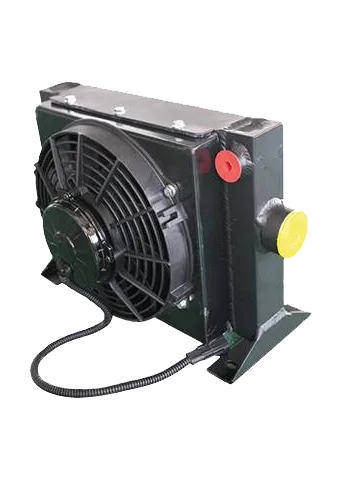
A fan oil cooler is defined as an air-cooled heat exchanger, and its main function is to cool the oil circulating within the system, which reaches high temperatures over time, using ambient air. This system plays a critical role in keeping the oil at an optimal temperature, especially in high-performance mechanisms such as hydraulic systems, motorized equipment, and industrial machines.
Fan oil coolers are exchanger systems structurally equipped with a fan, finned tubes (heat transfer surfaces), body, and connection parts. The operating principle is quite systematic and efficient: the overheated oil in the system is directed into coiled tubes (finned tubes) with the help of a pump. Air drawn or blown by the fan passes over the outer surface of these tubes. The fan takes heat from the oil by passing ambient air over the tubes, thereby cooling the heated oil in a controlled manner through the fan system.
During this process, the oil circulates in a closed circuit and does not come into direct contact with the outside air. This prevents the oil from being contaminated by external factors and allows the system to operate under hygienic conditions. This feature provides a critical advantage, especially in sensitive sectors such as food, pharmaceuticals, chemicals, and defense industries.
One of the most notable aspects of fan oil coolers is that they do not require an additional cooling fluid. In other words, they provide effective cooling using only air, without the need for external liquid circulation like water or glycol. This offers ease of installation and significantly reduces operating costs.
Furthermore, these systems can be easily integrated into narrow spaces due to their compact structures. They are frequently preferred in both stationary installations and mobile applications because they offer space efficiency and can respond quickly to high temperature changes.
In conclusion, fan oil coolers are reliable cooling systems that increase energy efficiency, extend the life of equipment, operate with low maintenance costs, and are easily integrable. By ensuring that the oil is maintained at the ideal temperature, they contribute to the sustainable, safe, and high-performance operation of systems in industrial infrastructures and heavy-duty applications.
Structure and Operating Principle of Fan Oil Coolers
The main factor that ensures the efficient operation of fan oil coolers is the engineering-focused components they possess and the harmonious operation between these components. Each part is specially designed to increase the heat transfer capacity of the system and to offer a long-lasting and maintenance-friendly structure.
Basic Components of a Fan Oil Cooler
• Cooler Body: The main structure where the oil circulates and heat transfer occurs. It is usually made from aluminum alloys with a high heat transfer coefficient. The body structure is designed to create maximum surface area, allowing heat to be expelled more quickly and effectively.
• Fan Housing: The outer structure that protects the fan from impacts, dust, and liquid contact. This housing also directs airflow, enhancing system performance and ensuring user safety. In industrial applications, the fan housing is manufactured to withstand high temperatures and harsh environmental conditions.
• Fan Blades and Blade Tips: Aerodynamically designed fan blades for directing air and increasing flow speed directly affect cooling efficiency. Special forms at the blade tips (winglet structures) reduce turbulence, providing a quieter and more powerful airflow.
• Finned Tubes (Finned Structure): These tubes are the main heat transfer surfaces where the oil circulates and exchanges heat with the environment. The finned structure increases the surface area thanks to thin metal fins mounted around the tubes. Thus, the contact surface with the air is expanded, allowing for faster and more efficient heat transfer.
Operating Principle
The operating principle of fan oil coolers is based on the basic principles of thermodynamics and is quite systematic. The operation steps can be summarized as follows:
1. Transfer of Heated Oil: The oil operating in motors, pumps, or hydraulic circuits within the system heats up over time. This oil, which exceeds a certain temperature threshold, is directed to the fan oil cooler via a circulation pump.
2. Circulation in Finned Tubes: The oil begins to circulate along the finned tubes inside the exchanger. These coiled structures allow the oil to progress over a longer distance, thereby increasing the duration and efficiency of heat exchange.
3. Airflow is Provided by the Fan: Simultaneously, the fan is activated, providing a high-flow air stream from the external environment directed to the outer surface of the tubes. This air allows the heated oil passing through the tubes to transfer heat to the outside.
4. Heat Transfer Occurs: Due to the temperature difference between the air blown by the fan and the finned tubes, heat is transferred to the outside. In this process, the oil is cooled, but since it does not come into direct contact with the air, the risk of contamination is eliminated.
5. Cooled Oil Returns to the System: The oil with reduced temperature re-enters the circuit and continues to circulate within the system. This cycle is continuously repeated, ensuring the system operates at a stable temperature.
Technical Advantages
Thanks to this structure and principle, fan oil coolers;
• Operate using only air without the need for an external cooling fluid,
• Can be installed without the need for complex piping systems,
• Respond quickly to temperature changes,
• Provide high cooling efficiency with low energy consumption,
• Have a compact structure that can be used in both mobile and stationary applications.
This modular and optimized operating principle of fan oil coolers makes them an indispensable cooling solution in both industrial production lines and mobile machines. The efficient operation of the system depends on the correct component selection and appropriate air circulation; therefore, suitable fan diameter, tube arrangement, and material choices are critically important according to the application need.
Where Are Fan Oil Coolers Used?
Fan oil coolers are widely used equipment to ensure the safe, efficient, and uninterrupted operation of many machines and systems in different sectors. The control of oil temperature is critically important for both system performance and equipment life. In this context, fan oil coolers find their place in a wide variety of industrial applications.
1. Construction and Mining Machinery
Heavy machinery operating in challenging field conditions has high-power and continuously operating engines. The engine oils used in such machines heat up excessively due to prolonged operation and high ambient temperature. Fan oil coolers ensure that this oil is kept at the ideal temperature, increasing engine efficiency and preventing wear and failures.
Usage examples:
• Excavators
• Drilling and breaking machines
• Tunnel boring machines
• Concrete pumps and tower cranes
2. Agricultural and Farming Machinery
Machines used in the agricultural sector are subjected to intense and prolonged operation, especially during harvest periods. Heating is a significant problem in the engines and hydraulic systems of vehicles such as tractors, harvesters, balers, and plows. Fan oil coolers ensure the efficient operation of these machines, contributing to the uninterrupted conduct of agricultural production.
Advantages:
• Prevents hydraulic system failures
• Extends the life of parts
• Reduces energy consumption
3. Industrial Applications
Fan oil coolers are also widely used in various equipment used in factories and production lines. Especially in continuously producing facilities, the temperature of the oil circulating in the system can reach critical levels over time. Thanks to fan oil coolers that come into play in this situation, it is possible for production lines to operate without interruption.
Usage areas:
• Compressor systems
• Press machines
• Injection molding machines
• Turbine and generator systems in power plants
• Gearboxes and transmission components
These systems offer long-lasting solutions while saving space due to their low maintenance cost and compact designs.
4. Transportation and Logistics Sectors
Fan oil coolers are integrated to ensure the efficient operation of vehicles operating in the transportation sector, even under moving and challenging conditions. Especially in high-performance systems such as rail systems, marine vehicles, and aircraft, the management of oil temperature in real-time is necessary.
Usage examples:
• Brake and engine cooling systems in locomotives and metro systems
• Diesel engines, gearbox systems in ships
• Landing gear hydraulic systems in aircraft
• Heavy-duty vehicles in road transportation
Fan oil coolers used in these areas are generally systems with high vibration resistance, compact, and high air flow.
5. Hydraulic and Renewable Energy Systems
Fan oil coolers are of critical importance for safe and efficient operation in all applications where hydraulic systems are present. Especially in continuously operating machines such as wind turbines, hydraulic presses, CNC machining centers, and solar tracking systems, the control of oil temperature is vitally important.
Usage advantages:
• Ensures the safety of high-pressure hydraulic oil circuits
• Prevents deformation of system components
• Increases energy efficiency in automation systems
Fan oil coolers are also preferred in mobile applications (e.g., generator sets, portable machines, cranes). Their ability to be integrated with different power sources through AC, DC, or hydraulic motor options makes them a versatile solution.
What Are the Differences from Other Oil Coolers?
Fan oil coolers stand out among oil cooling systems with their unique designs, easy-to-operate structures, and high energy efficiency, meeting modern industrial needs. They are preferred not only for their simple and compact structures but also for their low maintenance requirements, flexible installation possibilities, and long-lasting usage advantages. Compared to traditional exchanger systems, they offer superiority in many aspects. These differences are valuable not only in terms of technical performance but also in terms of practicality in field applications, ease of installation, and reduction of operating costs.
1. No Need for Extra Fluid
One of the most distinctive differences of fan oil coolers is that they use only air as the cooling medium. These systems do not require the circulation of an external fluid (such as water, glycol, or another cooling fluid). This eliminates the use of auxiliary equipment such as additional piping, pumps, expansion tanks, or valves during installation.
The results of this advantage:
• Installation time is shortened
• The risk of installation errors is reduced
• The total cost of the system decreases
• Operations such as fluid level monitoring are not required during use
Issues such as corrosion, algae formation, freezing risk, or leakage problems seen in water-cooled systems are completely eliminated in air-cooled fan systems.
2. Compact and Space-Saving Design
Fan oil coolers can be easily integrated into narrow and limited spaces due to their compact body structure. This feature provides a significant advantage, especially in mobile equipment, field applications, and facilities with limited installation space.
While traditional tubular or plate exchanger systems generally require more space, fan systems:
• Can be mounted vertically or horizontally
• Can be integrated into walls, platforms, or mobile equipment
• Can be easily used in portable applications
Additionally, many models have a modular structure, allowing systems of different capacities to be combined according to need.
3. Low Operating and Maintenance Cost
The absence of external fluid requirements also significantly reduces operating expenses. Maintenance items such as chemical addition, water treatment, and circuit cleaning processes required in systems using water or glycol are not necessary in these systems.
Maintenance advantages of fan oil coolers:
• More resistant to contamination and clogging
• Simple cleaning and filter replacement are sufficient
• Does not require coolant fluid replacement or filling
• Service times are shorter, reducing downtime
These features are critically important for operational continuity, especially in remote or unmanned systems.
4. Energy Efficiency and Smart Control Capability
Modern fan oil coolers can be equipped with thermally controlled or speed-adjustable fans to increase energy efficiency. This feature ensures that the fan is activated only when needed, preventing unnecessary energy consumption.
Energy optimization in fan systems:
• Thermostat-controlled fan operation
• Variable speed (inverter-controlled) motors
• Automatic activation systems that prevent overheating
• Ability to operate with solar panels or alternative energy sources
Since energy consumption is one of the biggest cost items in industrial facilities, these features provide significant savings in the long run.
MIT Fan Oil Coolers: Optimized for Industrial Performance
In today's industry, efficient heat management is vital not only for system safety but also for operational continuity, cost control, extending equipment life, and energy savings. Especially in hydraulic and mechanical systems operating under high temperatures, maintaining the oil temperature in balance is a critical factor directly affecting system performance. MIT branded fan oil coolers are designed as advanced cooling systems equipped with high engineering standard components to meet this need, offering durable, efficient, and compact solutions. The product range provides flexible, reliable, and high-performance solutions for both stationary industrial installations and mobile equipment operating under challenging conditions. Technical Structure and Innovative Features
MIT fan oil coolers are equipped with many technical improvements to enhance their performance and maintain reliability during long-term use. The prominent structural and functional features of these systems are as follows:
• High-Resistant Aluminum Alloy Fin Structure The special aluminum alloys used in cooling surfaces have a high heat transfer coefficient, accelerating the heat transfer process. This structure, which also has high corrosion resistance, shows superior durability against external environmental conditions. It offers long-lasting use even in environments exposed to different weather conditions.
• Special Configuration of Tubes The tubes through which the oil circulates are designed with special geometries instead of standard straight lines. This design allows the oil to transition from laminar flow to turbulent flow regime. Turbulence increases the contact area with the surface, allowing for more effective heat transfer. Thus, more cooling is achieved in a shorter time.
• Vacuum Brazing Technology The fin and tube joints are fixed using a special brazing method performed in a vacuum environment. This process creates high-pressure and temperature-resistant, leak-proof, and long-lasting connections. Compared to traditional welding methods, it provides less deformation and higher structural integrity.
• Multiple Motor Option (AC, DC, and Hydraulic Motors) To ensure seamless integration with different systems, MIT fan oil coolers are offered with models that can operate with alternating current (AC), direct current (DC), or hydraulic motors. This diversity allows for adaptation to a wide range of applications from stationary industrial lines to mobile construction machinery.
Application Advantages and Industrial Compatibility
MIT fan oil coolers have a product profile that is not only technically but also ergonomically, economically, and environmentally compatible. Thanks to their compact body structure, they can be easily integrated into narrow spaces, used in portable systems, and are suitable for both horizontal and vertical mounting.
Additionally:
• Due to its lightness, it does not increase machine load in mobile applications,
• It is suitable for heavy field conditions due to its high vibration resistance,
• It can be preferred in areas with noise sensitivity due to its quiet operation feature,
• Provides high performance with low consumption through high energy efficiency fan systems.
With these aspects, MIT fan oil coolers are a preferred solution in many sectors, providing high reliability from hydraulic systems to agricultural machinery, compressors to generators, power plants to construction machinery.
Conclusion: Sustainable Performance and Safe Operation in Industry with Fan Oil Coolers
In today's high-paced and competitive industrial environments, it is not enough for machines to have only a strong and durable mechanical structure. True efficiency comes from being able to operate these machines in stable thermal conditions, continuously and safely for long periods. Thermal balance, which directly affects the performance of industrial equipment, is a critical factor, especially in hydraulic systems, motor-driven machines, and energy-intensive processes.
At this point, fan oil coolers stand out as a strategic solution for heat management. Keeping the oil temperature under control not only ensures the system operates for a longer time but also reduces the risk of failure, decreases maintenance costs, ensures production continuity, and ultimately increases the overall efficiency of the business.
Sectoral Flexibility and Application Diversity
Fan oil coolers, with their compact structures, high heat transfer efficiency, low energy consumption, and flexible installation possibilities, can be used in many different areas of industrial and mobile systems. They serve in a wide variety of environments, from excavators on construction sites to tractors in field conditions, offshore platforms to power plants, railway vehicles to defense industry equipment. This versatile usage capability shows that fan oil coolers are fully compatible with modern engineering solutions.
Especially in applications with harsh environmental conditions such as high temperature, dust, humidity, vibration, and continuous load, keeping the oil temperature under control provides the following benefits:
• Prevention of energy losses and increase in system efficiency,
• Maintaining system precision by keeping oil viscosity in the ideal range,
• Ensuring sealing elements function for a long time without deformation,
• Reduction of wear caused by friction on surfaces,
• Longer planned maintenance intervals and shorter unplanned downtime,
• Minimization of system failures requiring urgent intervention.
TCO (Total Cost of Ownership) and Contribution to Operational Economy
Fan oil coolers provide advantages to businesses not only in terms of initial investment cost but also in terms of total cost of ownership (TCO). The simple structure of these systems eliminates the need for additional elements such as external cooling circuits, pumps, valves, or expansion tanks, minimizing maintenance costs and energy consumption.
• Installation ease provides labor and time savings.
• Since it does not require external fluid, risks such as leakage, freezing, and water quality problems are eliminated.
• Automatic temperature balancing can be done with advanced fan control units.
• The modular design of the system allows for capacity increase or changes according to need.
For all these reasons, fan oil coolers transform into an infrastructure solution that provides measurable benefits such as a stable production environment, reduced maintenance needs, increased system life, and low operating costs, quickly recouping the investment.
Technically Distinctive Features
The technical advantages offered by fan oil coolers compared to classic exchanger systems are as follows:
• A simple system that operates only with air: There is no need for additional cooling fluids like glycol or water.
• Compatibility with AC, DC, or hydraulic motors: Can work fully integrated with different power sources.
• Modular structure: Offers easy installation and system expansion flexibility even in tight spaces.
• Advanced fan technology: Fan speed can be automatically adjusted with temperature sensors, thus optimizing energy efficiency.
• High vibration-resistant body: Works safely even in challenging field conditions.
Fan oil coolers are safe, economical, and high-performance heat management solutions that meet the industrial needs of today and tomorrow. They are not just an auxiliary system but a critical investment item that guarantees the efficient operation of the entire production line.
With their long-lasting, durable, and user-friendly structure, fan oil coolers have become one of the cornerstones of industrial reliability and have been adopted as standard equipment by many sectors. Especially with smart fan controls that can be integrated into modern automation systems, these systems serve not only today's but also the sustainable production understanding of the future.