Differences in Operating Principles
Blowers and Roots blowers operate on fundamentally different principles in terms of air delivery methods. This difference directly affects which product should be preferred for which application.
Centrifugal blowers deliver air by throwing it from the center to the periphery through a fan (impeller) rotated by a motor. As the impeller rotates, the air gains speed due to the effect of centrifugal force and is directed within the blower body to be transferred to the outlet channel. During this process, the airflow is continuous, and the pressure increase occurs gradually. This structure is ideal for applications where high airflow transfer is required but the pressure need is relatively low.
Roots blowers, on the other hand, operate on the positive displacement principle. The two lobed rotors located within the body rotate in synchronization without touching each other and transport a specific volume of air from the intake to the outlet. In this system, air compression occurs not within the blower body but with the system resistance in the outlet line. Therefore, Roots blowers are preferred in processes that require a constant and controlled air volume, high pressure, or high vacuum.
When evaluated in terms of operating principles; centrifugal blowers stand out in ventilation and general industrial applications that require high flow rates and continuous air circulation, while Roots blowers offer a more suitable solution in applications where pressure and vacuum are critical and process control is paramount.
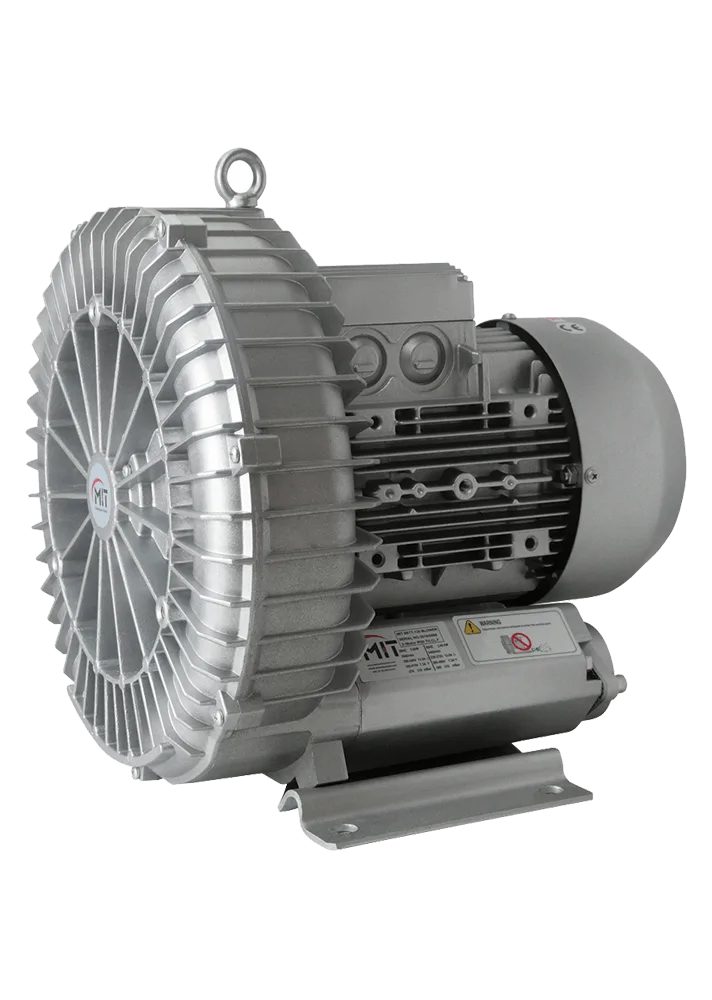
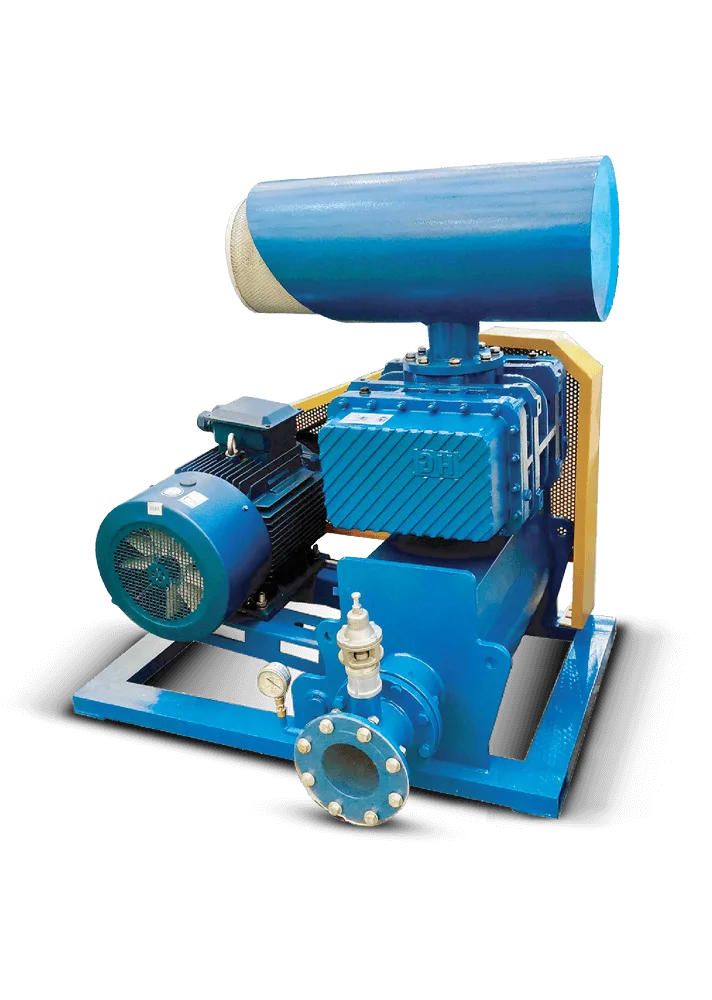
One of the most important criteria determining the choice between blowers and Roots blowers is the air flow rate and pressure range required by the system. These two types of equipment cater to different applications in terms of how they produce these values and their limits.
Centrifugal blowers are designed to provide high flow rates but low to medium pressure air flow. These systems, which operate by accelerating air over the impeller, yield efficient results especially in applications where air circulation is required in large volumes. Since the pressure increase is gradual, they are preferred in systems that require stable and continuous airflow rather than processes that need sudden and high pressure. This characteristic provides a significant advantage in ventilation, drying, dust extraction, and general industrial air transfer applications.
Roots blowers, thanks to their positive displacement structures that carry a specific volume of air at a constant rate, can achieve higher pressure and vacuum values. The flow rate is more stable, independent of system resistance. This feature makes Roots blowers prominent in applications requiring pipelines, pneumatic conveying systems, and deep vacuum. They are preferred in processes where the pressure requirement is constant and controlled, and a stable air supply is necessary.
From this perspective; in applications requiring high air volume where pressure is secondary, centrifugal blowers offer a more suitable solution, while Roots blowers are preferred in systems that need to transport air at a higher pressure or vacuum at a specific flow rate.
Performance in Vacuum and Pressure Applications
Vacuum and pressure applications are among the most critical process requirements that determine blower selection. Blowers and Roots blowers exhibit different performance characteristics in these types of applications.
Centrifugal blowers provide effective performance in applications requiring low and medium levels of pressure or vacuum. Thanks to the principle of accelerating air with centrifugal force, the flow is continuous, but the produced vacuum and pressure values are limited. Therefore, they are more suitable in systems where air intake or blowing plays a supportive role and does not carry the main load of the process. This structure yields sufficient and efficient results in dust extraction, air circulation, drying, and general ventilation applications.
Roots blowers, on the other hand, can achieve much higher and controlled values in vacuum and pressure applications. Thanks to their positive displacement structures, they continue to carry the specified air volume even if system resistance increases. This feature makes Roots blowers indispensable in applications that require deep vacuum or where pressure directly affects process quality. Wastewater treatment plants, pneumatic conveying systems, biogas applications, and gas discharge lines can be cited as examples of these usage areas.
When evaluated in this direction; in systems where vacuum and pressure are auxiliary elements and are sufficient at low levels, centrifugal blowers are preferred, while in applications where vacuum or pressure is central to the process and must remain stable, Roots blowers are a more accurate choice.
Suitability for Continuous and Intermittent Operation
The operating time and continuity of blower systems in industrial applications are important factors that directly affect equipment selection. Blowers and Roots blowers adapt to continuous and intermittent operating conditions in different ways.
Centrifugal blowers are suitable for applications requiring long-term and continuous operation. Thanks to the principle of gradually accelerating air, the load distribution is balanced, and the system exhibits a more stable character. This structure provides advantages in industrial facilities with ventilation systems that operate all day, air circulation in production areas, drying lines, and continuous processes. Their flow-focused operations allow the system to operate stably without being exposed to sudden load changes.
Roots blowers are suitable for both continuous and intermittent operation, especially preferred in process-oriented systems. Because they carry the same air volume in each cycle due to their positive displacement structures, they do not experience performance loss even in applications where the process is activated and deactivated at certain intervals. This feature provides a significant advantage in systems like wastewater treatment plants, pneumatic conveying systems, and gas discharge applications where the process can be loaded instantaneously.
From this perspective; in applications requiring stable and long-term air circulation, centrifugal blowers stand out, while in systems where process loads are variable or where there is an expectation of high performance at certain intervals, Roots blowers offer a more suitable solution.
Energy Efficiency and Electricity Consumption
Energy consumption is one of the most considered criteria in the selection and operation process of blower systems. Blowers and Roots blowers have different characteristics in terms of energy efficiency due to their operating principles.
Centrifugal blowers offer high energy efficiency in applications requiring low and medium pressure. Since the airflow is naturally adjusted according to the system resistance, unnecessary energy consumption does not occur. Especially in applications such as air circulation, ventilation, and drying in large volume areas, a properly selected centrifugal blower can provide high performance with low electricity consumption. This feature creates a significant advantage in continuous operation systems where energy costs are critical.
Roots blowers, due to their positive displacement structures, carry a certain volume of air regardless of the system resistance. This situation provides a performance advantage in applications requiring high pressure or vacuum, but it may lead to higher energy consumption. However, in systems where the pressure or vacuum values of the process are critical, this energy consumption is considered an acceptable necessity in terms of process safety and continuity.
In this context, centrifugal blowers provide a more efficient solution in applications where the pressure requirement is low and the airflow progresses freely, while Roots blowers provide a more stable and reliable performance at the cost of energy consumption in processes where high pressure or vacuum is mandatory.
Noise Level and Vibration Characteristics
The noise and vibration levels generated by blower systems in industrial facilities are important evaluation criteria in terms of both operational comfort and the area where the equipment will be positioned. Blowers and Roots blowers exhibit different behaviors in this regard.
Centrifugal blowers create a more balanced and fluid air movement due to their operating principles. The gradual acceleration of air and the dynamic balance adjustment of the fan result in a structure with low vibration. This situation allows for a more controlled noise level. Especially in production areas, closed facilities, and environments with high human density, centrifugal blowers offer a more comfortable working environment. This feature is a significant advantage in HVAC and general ventilation applications where noise sensitivity is a priority.
Roots blowers, due to their positive displacement structures, have a more pronounced mechanical working character. The pressure fluctuations occurring during the synchronized rotation of the rotors can cause the noise level to be higher compared to centrifugal blowers. However, this situation is generally at an acceptable level in industrial processes. With appropriate silencer and insulation solutions, the noise generated by Roots blowers can be controlled.
From this perspective, in applications requiring quiet operation, those that involve humans, or closed spaces, centrifugal blowers offer a more suitable option, while in heavy industrial applications where process priority is high and noise is secondary, Roots blowers may be preferred.
High Temperature and Harsh Environment Resistance
In industrial processes, blower systems are often exposed to harsh conditions such as high temperatures, dusty environments, humidity, chemical gases, and continuous operation under load. Therefore, the environmental resistance of the equipment is an important factor that determines its area of use.
Centrifugal blowers provide successful performance in the transfer of air at high temperatures. Thanks to their fan structure and body design, they can adapt to hot air flow. Centrifugal blowers are commonly preferred in drying systems, hot air circulation, and process support applications. In dusty environments, when used with appropriate filtration and protective equipment, they create a reliable solution.
Roots blowers demonstrate high resistance to harsh industrial environments due to their mechanical structures. The body structure and rotor design provide stability in systems operating under high pressure. Roots blowers operate reliably in environments with intense dust and dirt encountered particularly in heavy industry, wastewater treatment plants, mining, and the cement sector. However, in high-temperature applications, it is important to correctly design the system and select suitable materials.
From this perspective, in applications where the transfer of air at high temperatures is a priority, centrifugal blowers provide an advantage, while in heavy industrial applications where mechanical durability and adaptation to harsh environmental conditions are critical, Roots blowers are a more suitable choice.
Suitability for Precise Processes
In some industrial applications, maintaining airflow, pressure, and vacuum values within certain tolerances is critical for process quality. The type of blower used in such precise processes directly affects system performance.
Centrifugal blowers are suitable for processes where pressure fluctuations can be tolerated because they provide airflow in a soft and continuous manner. Gradual acceleration of air prevents sudden changes. However, changes in system resistance can affect the produced flow rate and pressure values. Therefore, centrifugal blowers are preferred in applications where high precision is not required but stable air circulation is expected.
Roots blowers, due to their positive displacement structures, carry the same volume of air with each rotation. This feature ensures that pressure and flow rate values remain constant throughout the process. Roots blowers stand out in areas where precise control of the process is required, such as pneumatic conveying, dosing support systems, biogas, and gas discharge applications. The stability in airflow provides a significant advantage in terms of process safety and product quality.
In this regard, in general industrial applications where small fluctuations in airflow do not pose a problem, centrifugal blowers offer a sufficient solution, while in precise processes where flow rate and pressure stability are critical, Roots blowers are a more accurate choice.
Use in Industrial Conveying Systems
In industrial conveying systems, airflow ensures the safe, controlled, and uninterrupted transport of materials. The type of blower used in these systems is determined by the structure of the material being transported and the process requirements.
Centrifugal blowers are preferred in systems where lightweight materials are transported or where air support plays an auxiliary role. Due to their ability to produce high flow rates at low and medium pressures, they provide efficient results in short-distance transport lines and open systems. Centrifugal blowers are commonly used in dust extraction, light granule transfer, and general industrial air-supported transport applications.
Roots blowers, on the other hand, are one of the essential equipment in pneumatic transport systems. Thanks to their positive displacement design, they provide a constant and controlled air volume along pipelines. This feature creates a significant advantage in long-distance transport lines and closed-loop systems with high system resistance. Roots blowers offer reliable performance in the transportation of materials such as cement, sugar, plastic granules, ash, and similar substances.
From this perspective, while centrifugal blowers are sufficient in applications requiring short-distance, low-pressure transport of lightweight materials, Roots blowers should be preferred in long-distance and closed-loop pneumatic transport systems.
Wastewater Treatment and Environmental Applications
Blower systems used in wastewater treatment and environmentally focused processes play a critical role in terms of continuous operation, high reliability, and process stability. In these applications, air is one of the essential inputs for biological treatment processes.
Centrifugal blowers can be used in treatment systems where continuous air supply at low and medium pressures is sufficient. Especially in small and medium-sized facilities, where the need for ventilation does not vary significantly throughout the process, centrifugal blowers offer a suitable solution. In applications where air needs to be distributed homogeneously, a continuous and balanced airflow provides an advantage.
Roots blowers are one of the most commonly used types of blowers in wastewater treatment plants. Thanks to their positive displacement design, they can provide a constant air flow rate even if the pool depth or system resistance changes. This feature allows for the control of oxygen levels in biological treatment processes. Additionally, their design suitable for long-term and challenging operating conditions makes Roots blowers stand out in environmental applications.
In this regard, while centrifugal blowers may be preferred in small-scale and limited pressure treatment systems, Roots blowers offer a more reliable solution in wastewater treatment plants requiring deep pools, high flow rates, and pressure.
Selection Criteria in Food and Pharmaceutical Industries
Blower systems used in the food and pharmaceutical industries must meet high standards in terms of hygiene, safety, and process control. The quality of the air produced, the structure of the equipment in contact with the process, and the stability of the system are determining factors in these sectors.
Centrifugal blowers are generally preferred in auxiliary air systems for food and pharmaceutical applications. Their ability to produce oil-free air and balanced airflow provides safe usage in drying, ventilation, packaging support lines, and general facility air applications. In systems where the airflow does not come into direct contact with the product but supports the process environment, centrifugal blowers are a sufficient and efficient solution.
Roots blowers, on the other hand, are more commonly used in process-oriented applications in the food and pharmaceutical sectors. In pneumatic transport systems, dosing supports, and lines requiring controlled air supply, Roots blowers stand out. By providing a constant and controlled air volume, they help maintain stable process parameters during production. In such applications, hygienic design, appropriate filtration, and proper system integration are of great importance.
From this perspective, while centrifugal blowers are preferred in off-process and supporting air applications, Roots blowers offer a more suitable solution in applications where airflow is part of the production process and requires control.
Energy, Cement, and Heavy Industry Applications
Energy production, cement, and heavy industry facilities have processes characterized by high dust loads, continuous operation, high pressure requirements, and challenging environmental conditions. In these sectors, the selection of blowers is critically important for system reliability and process continuity.
Centrifugal blowers are generally used in auxiliary systems in heavy industry applications. They provide high flow air circulation in dust collection, ambient ventilation, cooling, and process support lines. In applications where pressure requirements are limited and airflow is more focused on improving environmental conditions, centrifugal blowers offer sufficient performance.
Roots blowers, however, stand out as the main process equipment in energy, cement, and heavy industry applications. Thanks to their positive displacement design, they provide stable air supply even under high pressure. In processes such as pneumatic transport systems, ash and dust transfer, biogas, and gas discharge lines, Roots blowers offer a reliable and controlled solution. Their mechanical structure suitable for challenging working conditions allows for long-term and uninterrupted operation in these sectors.
In this context, while centrifugal blowers are preferred in auxiliary and supporting air systems, Roots blowers are a more appropriate choice in heavy industry applications that are part of the main process and require high pressure.
Use in HVAC and Ventilation Systems
In HVAC and ventilation systems, blowers play a fundamental role in ensuring indoor air quality, temperature control, and the continuity of air circulation. In these applications, high flow, low pressure, and quiet operation are generally prioritized.
Centrifugal blowers are among the most commonly used equipment in HVAC and ventilation systems. Their ability to provide high air flow, produce balanced airflow, and maintain low noise levels makes them an ideal solution for comfort climate applications. In ventilation systems used in shopping malls, office buildings, industrial facilities, and production areas, centrifugal blowers reliably perform their tasks.
Roots blowers have a limited application area in HVAC applications. They are preferred in specific ventilation scenarios that require more pressure or vacuum, such as local extraction systems or special process areas that require closed-loop air supply. However, due to their positive displacement design, they are less common in general HVAC systems compared to centrifugal blowers.
When evaluated from this perspective; in general HVAC and comfort ventilation applications, centrifugal blowers are the most suitable solution, while Roots blowers may be preferred in limited ventilation applications where there is a need for special pressure or vacuum.
In Which Cases Should a Blower Be Preferred
When selecting a blower, the air flow rate, pressure level, and operating characteristics required by the application should be taken into account. Centrifugal blowers provide a more efficient and suitable solution under certain conditions.
Blowers should be preferred in applications where air transfer needs to occur at high flow rates but at low or medium pressure. Especially in large volume areas, centrifugal blowers provide effective performance in air circulation, ambient ventilation, and process support applications. This setup offers advantages in systems where continuous and stable airflow is sufficient, and pressure is not a critical parameter.
Additionally, in systems where quiet operation is important, in areas with high human density, or in enclosed spaces, centrifugal blowers are a more suitable option. HVAC systems, drying lines, dust extraction, and general industrial ventilation applications fall under this category.
In this regard, it should be noted that in applications where high flow rate needs are prioritized, and pressure and vacuum requirements are limited, centrifugal blowers should be preferred.
In Which Cases Should a Roots Blower Be Preferred
Roots blowers are equipment developed for applications where process control and pressure or vacuum values are critical. Therefore, the reasons for their preference differ from those of centrifugal blowers.
In systems where a constant and controlled air volume is mandatory, Roots blowers come to the forefront. Thanks to the positive displacement working principle, the specified flow rate is maintained even if the system resistance changes. This feature provides significant advantages in processes such as pneumatic conveying systems, wastewater treatment plants, biogas applications, and gas discharge lines.
In applications requiring high pressure or deep vacuum, Roots blowers offer a more reliable solution. They can operate without performance loss, especially in long piping systems, closed-loop systems, and industrial applications directly dependent on the airflow of the process. This is the main reason why Roots blowers are commonly preferred in energy, cement, mining, and heavy industry facilities.
From this perspective, in systems where pressure and vacuum are central to the process, flow stability is critical, and systems operate under challenging industrial conditions, Roots blowers should be preferred.