In the food and beverage industry, hygiene, product safety, and compliance with legal regulations are among the most critical requirements. Organic residues, fats, proteins, and sugar-based contaminations that occur on production lines, if not cleaned adequately, reduce product quality and open the door to microbiological risks. CIP (Clean in Place) systems offer on-site and controlled cleaning possibilities without the need to disassemble production equipment to eliminate these risks.
Thanks to CIP systems, tanks, pipelines, filling machines, pasteurizers, and heat exchangers can be cleaned automatically. Standardizing the cleaning process ensures that the same level of hygiene is achieved in every washing cycle. This situation creates a significant advantage in terms of quality continuity, especially in facilities where food safety standards are high.
One of the most important contributions of CIP systems in food and beverage production facilities is time and labor savings. While manual cleaning processes require production to stop and equipment to be disassembled, CIP systems operate with minimum downtime on the production line. This increases production efficiency while reducing operating costs.
Controlling chemical and water consumption is another factor that enhances the importance of CIP systems in the food sector. Automatic systems that work with conductivity measurement ensure that cleaning chemicals are used at the correct concentration. Chemicals used can be recovered and reused thanks to chemical solution tanks. This approach supports environmental sustainability and reduces operating expenses.
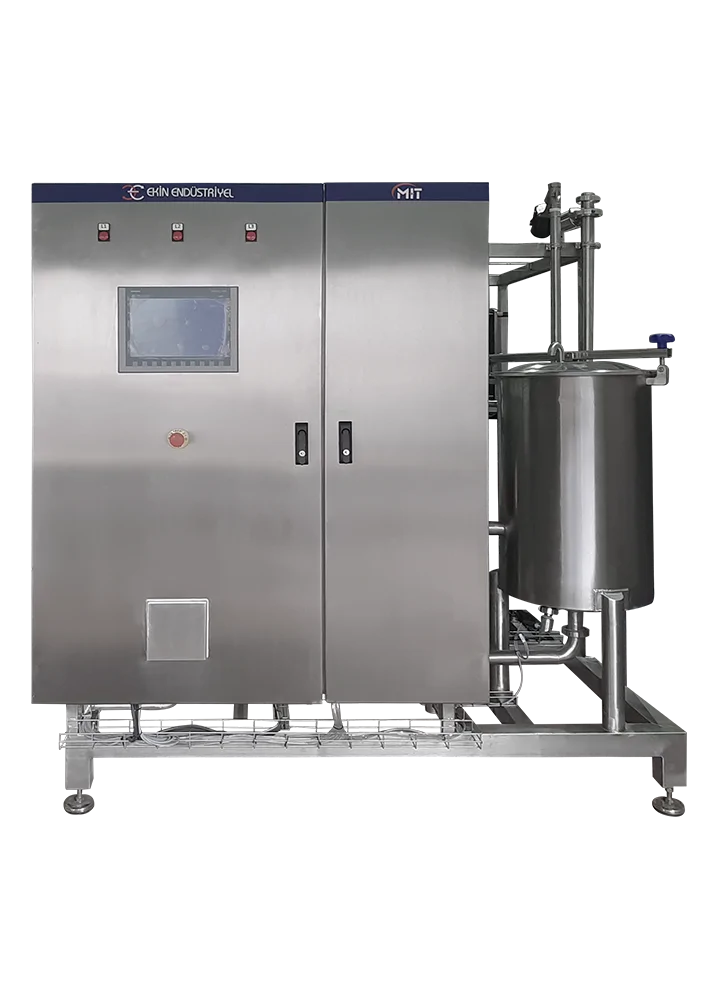
CIP systems used in the food and beverage industry stand out with their stainless steel structures that comply with hygienic design principles. Easily cleanable surfaces, design details that do not create dead volumes, and equipment resistant to high temperatures enhance process safety. Thus, production lines continue to operate in accordance with national and international hygiene standards.
CIP Applications in Milk and Dairy Product Production Facilities
The production of milk and dairy products is among the most sensitive processes from a microbiological perspective. Products such as milk, yogurt, cheese, buttermilk, and similar items can quickly cause contamination on production lines due to their protein, fat, and lactose content. Therefore, it is of great importance that cleaning and sanitation processes in the dairy industry are accurate, regular, and repeatable. CIP systems are widely used in milk and dairy product facilities to meet these requirements.
CIP systems in milk processing facilities play an active role in cleaning critical equipment such as raw milk tanks, balancing tanks, pasteurizers, homogenizers, pipelines, filling machines, and heat exchangers. The ability to clean this equipment on-site without disassembly ensures that hygiene levels are maintained and supports production continuity.
Contaminations encountered in dairy product production are generally protein and fat-based. The alkaline and acidic washing cycles applied in CIP systems allow for the effective removal of these residues. Depending on the requirement, thermal sanitation or chemical disinfection options can also be applied. This flexibility facilitates the maintenance of hygiene standards in facilities where different product groups are produced.
Automatically operating CIP systems minimize human error in the dairy industry. By keeping conductivity, temperature, and time parameters under control, each cleaning cycle is performed to the same quality standards. This ensures the continuity of product quality while also facilitating inspection and validation processes.
Another significant advantage of CIP systems in milk and dairy product facilities is the optimization of water and chemical consumption. Cleaning chemicals can be recovered and reused through chemical solution tanks. This provides significant economic and environmental benefits for businesses.
Hygienic design stainless steel CIP systems are designed to be fully compatible with the equipment used in the dairy industry. Smooth surfaces, appropriate slopes, and connections that do not create dead volumes maximize cleaning efficiency. Thus, milk and dairy product production facilities can sustainably meet high hygiene requirements.
CIP Systems in Soft Drink, Carbonated Beverage, and Juice Lines
Process hygiene in soft drink, carbonated beverage, and juice production facilities is critical for product quality and shelf life. Products containing sugar, flavor, acid, and fruit extract can create sticky and hard-to-clean residues on production lines. To effectively eliminate such contaminations, CIP systems are used as a standard cleaning solution in the beverage industry.
CIP systems in beverage production lines actively play a role in cleaning mixture tanks, syrup preparation units, carbonators, filling machines, pipelines, and heat exchangers. Cleaning on-site without the need to disassemble equipment ensures that production continuity is maintained while hygiene standards are continuously applied.
In carbonated beverage and soft drink lines, CIP systems provide high efficiency, especially in the removal of sugar and acid-based residues. Controlled application of alkaline and acidic washing steps helps completely clean residues accumulated on surfaces. In juice production, CIP applications are crucial for eliminating the risk of biofilm formation caused by pulp and natural sugar residues.
Automatic CIP systems standardize cleaning processes in the beverage industry. Automatic control of temperature, duration, and chemical concentrations allows each washing cycle to be completed at the same level of hygiene. This not only preserves product quality but also facilitates quality control and inspection processes.
Optimizing water and chemical consumption is one of the important reasons for the preference of CIP systems in soft drink and juice facilities. Cleaning chemicals used can be recovered and reused thanks to chemical solution tanks. This approach reduces operating costs and contributes to environmental sustainability.
Stainless steel CIP systems produced in accordance with hygienic design principles offer safe and long-lasting use in beverage production lines. Thanks to smooth surfaces and design details that do not create dead volumes, cleaning efficiency is increased, and production lines continue to operate in compliance with national and international hygiene standards.
Hygienic Cleaning Systems in Ready-to-Eat Food and Process Lines
Hygiene is one of the most critical elements in ready-to-eat food production facilities, in terms of product safety and consumer health. In these facilities where cooked, semi-cooked, or ready-to-eat products are produced, even the smallest contamination that may occur in the production lines can lead to serious quality and safety issues. CIP systems provide hygienic and controlled cleaning solutions to minimize these risks in ready-to-eat food processes.
CIP systems are effectively used for cleaning cooking tanks, mixers, sauce preparation units, pipelines, and pre-filling and packaging process equipment in ready-to-eat food production lines. These systems, which offer the possibility of cleaning on-site, prevent time loss by allowing cleaning to be done without the need to disassemble the equipment and support production continuity.
Contaminations encountered in such production processes generally consist of complex substances such as fats, starches, proteins, and sauce residues. The multi-stage washing cycles applied in CIP systems allow for the effective removal of these residues. Depending on the requirements, thermal sanitation or chemical disinfection steps can be added to further enhance the hygiene level.
Automatic CIP systems in ready-to-eat food facilities standardize cleaning processes. Thanks to the automatic control of temperature, duration, and chemical concentrations, each cleaning cycle is carried out at the same quality and hygiene level. This approach offers significant advantages in terms of quality continuity, especially in facilities with high production capacities.
Optimizing water and chemical consumption is one of the important reasons for the preference of CIP systems in the ready-to-eat food sector. Cleaning chemical solutions can be recovered and reused with chemical solution tanks. This not only reduces operating costs but also supports environmental sustainability.
Stainless steel CIP systems produced in accordance with hygienic design principles provide safe and long-lasting use in ready-to-eat food production lines. Cleaning efficiency is enhanced through smooth surfaces, appropriate drainage slopes, and connections that do not create dead volumes, allowing production lines to continue operating in compliance with high hygiene standards.
Use of CIP Systems in Pharmaceutical and Biotechnology Facilities
In the pharmaceutical and biotechnology sectors, hygiene is critically important not only for product quality but also for legal regulations and validation requirements. The production processes in these facilities often require high precision, and even the slightest risk of contamination can render products unusable. CIP systems provide reliable and controlled cleaning solutions to meet these high hygiene requirements in pharmaceutical and biotechnology facilities.
CIP systems are used for cleaning reactors, mixing tanks, process pipelines, transfer lines, filtration systems, and heat exchangers in pharmaceutical production facilities. In biotechnology applications, CIP systems are preferred for the on-site cleaning of fermentation tanks, bioreactors, and sensitive process equipment. The ability to clean equipment without disassembly reduces contamination risk and supports production continuity.
Since the products used in this sector often contain active pharmaceutical ingredients, proteins, and biological materials, the cleaning processes must be verifiable and repeatable. CIP systems ensure that each cleaning cycle is carried out to the same standards by controlling parameters such as temperature, duration, flow rate, and chemical concentration. This significantly facilitates validation and documentation processes.
CIP systems in pharmaceutical and biotechnology facilities can offer thermal sanitation options along with chemical cleaning. Especially in processes with high microbiological risk, sanitation applications performed at high temperatures maximize hygiene levels. Depending on the requirements, multiple chemical uses can be supported to create specific cleaning scenarios for different types of contamination.
Controlling water and chemical usage is important in these sectors for both cost and environmental sustainability. Thanks to the chemical solution tanks used in CIP systems, cleaning chemicals can be recovered and reused. This approach contributes to reducing operating costs while optimizing resource usage.
Stainless steel CIP systems produced in accordance with hygienic design principles offer long-lasting and safe use in pharmaceutical and biotechnology facilities. Cleaning efficiency is enhanced through smooth surfaces, connections that do not create dead volumes, and structures resistant to high pressure and temperature. This allows facilities to continue their production in compliance with national and international hygiene and quality standards.