Actuators are drive mechanisms that automatically perform the opening and closing movements of valves used in industrial processes. Their primary function is to convert a signal from a control system into physical movement. This allows for fluid control, pressure management, and system safety to be achieved without operator intervention. Actuators are typically mounted on the valve body and regulate the flow by directly transmitting mechanical movement to the valve shaft.
With the development of industrial automation, actuators have become a critical component in ensuring that production lines operate in a safer, more orderly, and traceable manner. The automation of manual opening/closing operations minimizes human error in processes, enhances operator safety, and allows for faster control of the process. The use of actuators in valves located in hazardous, high-temperature, high-pressure, or hard-to-reach areas is indispensable.
Actuators operate by converting different energy sources, such as electric motors, compressed air, or hydraulic fluid, into motion. Therefore, they are categorized into three main types: electric, pneumatic, and hydraulic. Each actuator type is selected based on criteria such as torque requirements, rotation speed, physical conditions of the installation environment, operational safety requirements, and control precision. Thus, when the right actuator is matched with the right valve, process performance significantly improves, system efficiency increases, and operating costs are optimized.
Working Principle and Advantages of Electric Actuators
Electric actuators are automation equipment that generates the necessary driving power for opening and closing valves through an electric motor. The rotational motion created by the motor is transmitted to the gear mechanism located within the actuator body. This gear system provides stable performance throughout the opening-closing process by transferring the motion to the valve shaft with controlled and constant torque. The stability provided by the gear structure makes electric actuators ideal for processes requiring precise control.
One of the biggest advantages of electric actuators is the easy access to electrical energy in almost any environment. This means they do not require additional infrastructure investment and can adapt to systems offering various power options in the field. Thanks to their long-lasting motor structure and gear mechanism, they operate with minimal maintenance needs, providing high efficiency during operation. The silent operation principle is an important preference in facilities with noise sensitivity.
The wide operating voltage range allows electric actuators to integrate easily with different industrial control systems. Additionally, their wide rotation angle tolerance ensures high compatibility with many valve types, such as butterfly valves and ball valves. These features make electric actuators a preferred reliable solution in both newly established automation lines and the modernization of existing systems.
Truevalve Electric Actuator Features
Truevalve electric actuators are professional drive solutions designed to provide high durability, reliable performance, and long life in industrial processes. They support both 220V AC and 24V DC voltage options to ensure compatibility with different automation infrastructures. This versatility allows for quick integration based on the energy sources used in the field and eliminates the need for additional adaptation.
The actuator body is made from aluminum injection material. This production technique provides both lightness and high mechanical strength. The corrosion resistance offered by the aluminum structure allows for long-term use even in challenging processes where humid, chemically active, or outdoor conditions prevail. Additionally, the compact and robust body structure enhances system stability by increasing vibration resistance during installation.
One of the most important features of Truevalve electric actuators is their IP67 protection class. This level means complete protection against dust and high resistance to temporary water contact. This feature ensures that actuators can be safely used in open areas within the facility, in regions that may be exposed to water, or in lines with high particulate presence. Thus, businesses can extend maintenance intervals, enhancing both operational continuity and equipment lifespan.
The technical features offered by Truevalve make electric actuators an ideal solution for different valve types and control scenarios. They provide long-term performance in industrial applications where durability and reliability are expected.
Structure, Working Principle, and Applications of Pneumatic Actuators
Pneumatic actuators are drive mechanisms that convert compressed air energy into mechanical motion. They have a piston-cylinder or diaphragm mechanism in their internal structure, which directs compressed air into the actuator to create linear or rotary motion. Their lightweight body structures, fast operating capacities, and high durability make them reliable in many industrial processes.
Working with compressed air makes them a significant alternative, especially in areas where electrical use is hazardous or risky. Since electrical equipment can pose a spark risk in environments with explosive gases or flammable materials, pneumatic actuators provide a significant safety advantage in such hazardous areas. This feature creates a wide range of applications, from chemical plants to refineries, from paint application areas to production lines with explosion risks.
The installation cost of pneumatic actuators may be higher than electric actuators due to the need for a compressor. However, the low operating cost of compressed air makes the total cost advantageous in the long run. Additionally, the maintenance processes of pneumatic systems are generally simpler and allow for quick intervention.
One of the prominent features of these actuators is the availability of models with a fail-safe option. In these single-acting models, the spring mechanism automatically brings the valve to a safe position when the system power is cut off. This feature ensures the protection of equipment and facilities in applications where process safety is critical.
In general, pneumatic actuators are widely used in many industries such as food, automotive, chemical, petrochemical, metal processing, energy, textile, and HVAC, thanks to their advantages such as speed, durability, reliability, and suitability for demanding process conditions.
Differences Between Single-Acting and Double-Acting Pneumatic Actuators
Pneumatic actuators are divided into two main categories based on their operating principles: single-acting and double-acting. The difference between these two structures relates to how the actuator performs its movement and at which stages air pressure is used.
In single-acting pneumatic actuators, there is a spring mechanism inside the body. When compressed air is applied, the valve opens or closes; when the system stops supplying pressure, the internal spring activates and returns the actuator to its initial position. This operating principle provides a significant advantage, especially in facilities where process safety is critical. In cases of power failure, emergencies, or control system malfunctions, the valve automatically returns to a safe position. This feature, known as fail-safe, enhances facility safety and prevents uncontrolled processes.
In double-acting pneumatic actuators, there is no spring. Both the opening and closing movements are achieved with compressed air. This structure allows for stronger, faster, and more stable movement in both directions. Because there is no spring mechanism, they are preferred in larger valves and applications requiring higher power across a wider torque range. Additionally, since two-way air pressure is used, control sensitivity increases, providing a more balanced movement throughout the stroke.
In general, single-acting actuators are used in critical processes where safety is a priority, while double-acting actuators stand out in applications requiring high performance, stability, and a wider torque requirement. The choice between both types should be made according to the process's safety requirements, fluid characteristics, valve type, and torque needs.
Types of Valves Used in Pneumatic Actuators
Pneumatic actuators are designed to work with many types of valves used in different industrial processes. The driving force obtained from compressed air is directly transmitted to the valve shaft, allowing for precise control of the flow. Therefore, in systems where pneumatic actuators are preferred, the selection of the valve plays an important role in determining the performance to be obtained from the process.
The most commonly used types of valves with pneumatic actuators include gate valves, diaphragm valves, ball valves, butterfly valves, and plug valves. Gate valves provide full opening–full closing control in applications requiring high flow rates. Diaphragm valves are preferred in processes that require hygiene, ease of cleaning, and operation with corrosive fluids. Ball valves offer reliable and leak-proof control with their structures that can open and close in a short time. Butterfly valves create a lightweight and economical solution in large pipeline diameters due to their compact structures. Plug valves are preferred in processes where the flow characteristics need to be controlled more precisely.
Each valve type is matched with pneumatic actuators according to criteria such as the process's pressure level, flow viscosity, temperature range, and control sensitivity. The correct actuator-valve combination enhances both system efficiency and long-term operational performance. This ensures safer, faster, and energy-efficient flow control in facilities.
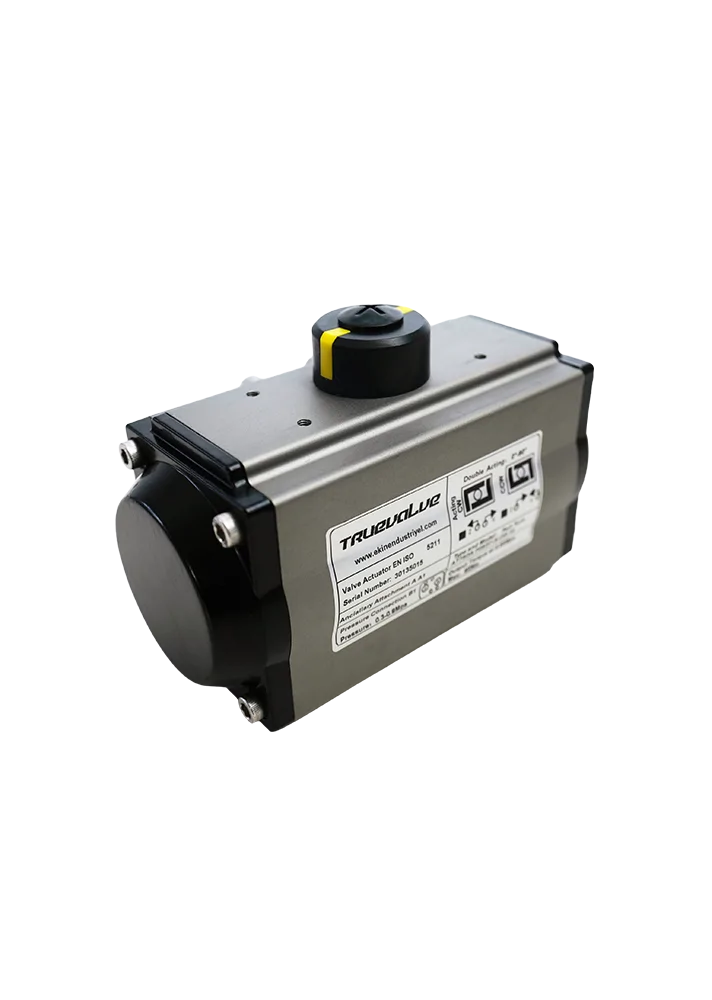
Truevalve Pneumatic Actuator Features
Truevalve pneumatic actuators are drive solutions developed to offer high performance, durability, and reliability in industrial automation systems. The availability of both single-acting and double-acting models allows them to adapt to different process needs. Single-acting models provide a safe solution for applications requiring emergency shutdown due to their spring mechanism, while double-acting models ensure stable control in valves requiring higher torque.
Truevalve pneumatic actuators are produced with an IP67 protection class. This level of protection means complete protection against dust and high resistance to water. Thus, the actuator can be safely used in open areas, humid environments, areas with water splashes, or process areas with high particle density. This level of durability extends maintenance intervals and contributes to the long-term stable operation of the equipment.
The aluminum extrusion material used in the body structure provides both lightweight and high strength to the actuator. This corrosion-resistant structure offers long-lasting use even in industrial conditions where chemical contact, moisture, or external environmental effects are intense. The aluminum extrusion manufacturing technique increases the mechanical strength of the body and enhances vibration resistance.
Truevalve pneumatic actuators are confidently preferred in many sectors such as food, automotive, chemical, metal, HVAC, energy, and textile due to their compatibility with different valve types and stable operating characteristics. With a durable body structure, high-performance drive capacity, and various operating options, they provide a strong and long-lasting solution for industrial flow control.
Sectors and Application Examples Where Actuators Are Used
Actuators serve as essential components in many industrial processes where fluid control is critical. Their automation of valve opening and closing operations directly affects both process safety and operational efficiency, making them widely preferred across a broad range of sectors. Each sector has different needs; actuators support the continuity of processes with durability, precision, and safety features suitable for these needs.
The food industry is one of the areas where hygiene and cleanliness requirements are at the highest level. Therefore, it is important that the valves used with actuators are easy to clean and made of stainless materials. Actuator solutions play a critical role in safely controlling the flow in dairy products, juice production, beverage filling lines, and processing facilities.
The automotive sector is an area where production lines are managed with intense automation. Accurate control of flow in testing systems, paint shops, coating applications, and cooling lines ensures the maintenance of quality standards. Actuators contribute to the automatic control of temperature and flow management.
Maritime applications involve challenging environmental effects such as saltwater, humidity, and external conditions. Therefore, equipment is expected to be corrosion-resistant and require low maintenance. Actuators provide long-lasting and reliable performance in cooling, heating, and flow control processes in ship systems.
In HVAC systems, increasing energy efficiency is a primary priority. In heating, cooling, ventilation, and domestic water applications, actuators optimize system performance by precisely managing the flow. This helps reduce energy costs while enhancing comfort in buildings.
The petrochemical and pharmaceutical industries face challenging processes such as working with high temperatures, high pressures, and corrosive fluids. Therefore, the actuators used must be durable, reliable, and compliant with safety standards. Actuators play a critical role in ensuring process continuity in these sectors.
The metal industry includes production lines exposed to high heat and intense pressure. In the automation of valves operating under such harsh conditions, actuators offer both durability and stable operation advantages.
The energy sector aims to increase efficiency in cogeneration systems and heat recovery applications. Actuators contribute to the sustainable continuation of operations by optimizing flow control in these systems.
The textile industry consists of many processes where temperature control is important, such as dyeing, finishing, washing, and drying. Actuators enhance production quality by providing stable flow and accurate temperature management in these processes.
As a result, actuators have a very wide range of applications due to their structures that can adapt to the needs of different sectors. The correct actuator model selected according to the process requirements in each sector directly affects system efficiency and operational safety.