Fluid management in industrial facilities is one of the most critical issues in terms of process safety and system efficiency. The valves used at this point play a vital role in controlling the direction, flow rate, and pressure of the fluid. Although there are many types of valves on the market, knife gate valves and ball valves stand out as two fundamental solutions that are most commonly used and cater to different needs.
Knife gate valves are preferred especially in systems where fluids containing sludge, sediment, fiber, or particles are transported. The sharp gate structure moving perpendicular to the flow direction prevents such impurities from obstructing the valve movement and provides reliable flow control. They offer a simple and effective solution by operating in a fully open or fully closed manner. High sealing is achieved with elastomer or metal seat options. They stand out with their long-lasting performance in challenging environments such as wastewater treatment plants, paper industry, mining, and chemical processes.
Ball valves are ideal for applications requiring quick opening-closing, low pressure drop, and high sealing in lines carrying clean fluids. The flow is controlled by rotating the perforated ball inside by 90°, and when the valve handle aligns with the flow, the flow becomes completely free. Their compact structure allows them to occupy minimal space in the pipeline, and maintenance requirements are minimal. With these features, they are widely used in a wide range from HVAC systems to chemical plants, energy production to the automotive industry.
In conclusion, when selecting valves in industrial systems, criteria such as the nature of the fluid, process requirements, sealing, and pressure values should be considered. Knife gate and ball valves, with their different operating principles and advantages, should be evaluated as two complementary solutions in industrial flow control; the right valve should be chosen for the right application.
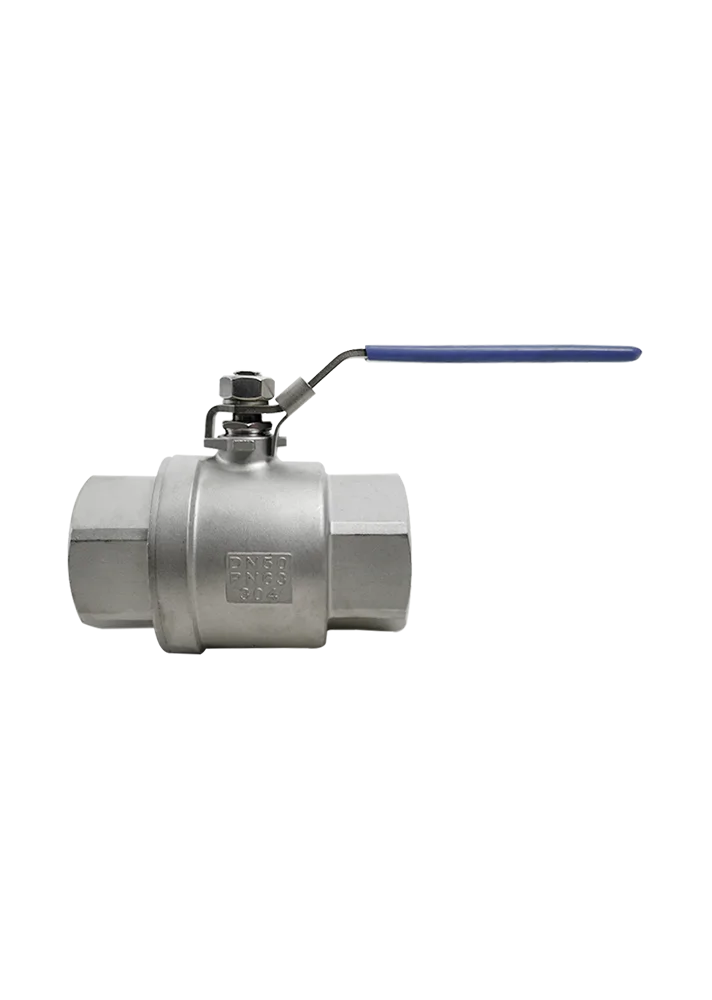
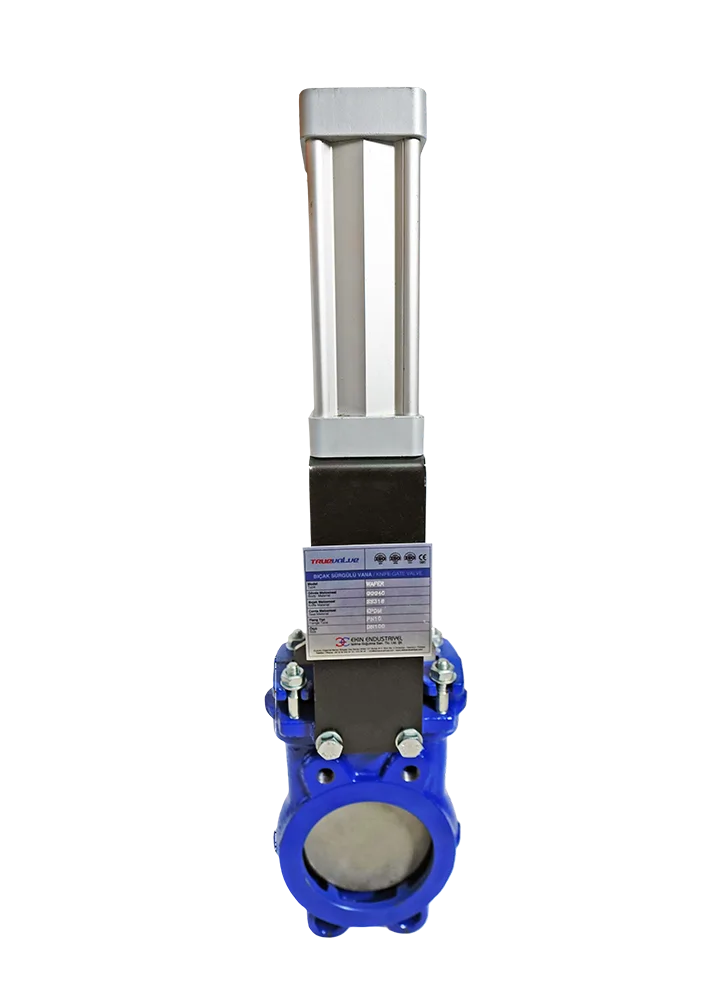
The main difference between knife gate and ball valves is the way the fluid is controlled and the operating principle of the moving parts inside the valve. This difference directly affects many technical details, from areas of use to performance values.
Knife gate valves operate with a flat gate (knife) that moves perpendicular to the direction of the fluid. This knife, moving up and down with the help of a valve handle or actuator, cuts off the flow path to close or open the system. Due to its structure, sediment, sludge, or solid particles in the fluid do not obstruct the valve movement; on the contrary, it is specially designed for such environments. However, this design makes precise flow control difficult. Therefore, knife gate valves are usually operated in "open" or "closed" positions and are classified as on-off type valves. With these features, they offer reliable solutions for demanding processes with low maintenance needs and high durability.
Ball valves, on the other hand, operate on the principle of rotating a ball with a hole by 90 degrees. When the valve handle is parallel to the flow direction, the hole aligns with the pipeline, and the fluid passes completely freely. When the handle is brought to the vertical position, the hole is misaligned with the flow, and the valve closes. This design offers very fast opening-closing capability and keeps system pressure losses to a minimum. Additionally, since ball valves can also be operated in a partially open position, a certain degree of flow control (throttling) can be performed. This makes them preferable in some precise applications.
In summary, while knife gate valves provide superior performance in challenging, particle-containing fluids and simple open-close applications, ball valves stand out with their advantages of quick response, low pressure drop, and high sealing in clean fluid systems. Choosing the right type of valve according to the process needs significantly increases both system efficiency and equipment lifespan.
Comparison in Terms of Sealing and Pressure Performance
One of the most important criteria in valve selection in industrial systems is the sealing capability and performance under high pressure. Because these two elements directly affect process safety and are critical factors determining operating costs and equipment lifespan. Knife gate and ball valves stand out with different design features in this regard.
Knife gate valves are structurally designed to provide high sealing. Elastomer seals (such as EPDM, NBR, NR) on both sides of the gate mechanism completely prevent fluid passage, creating strong sealing. In more challenging and abrasive environments, metal-seated versions are preferred to reduce the risk of seal deformation and extend valve life. Knife gate valves can generally operate safely in pressure ranges of PN10–PN16 and show durability at temperatures up to 150 °C. However, since they are not designed for precise flow control, it is not recommended to operate them in partially open positions; in this case, sealing performance may decrease over time.
Ball valves are known for their high sealing performance, making them indispensable for many industrial facilities. Thanks to the tight contact between the surface of the ball and the body and the use of PTFE seals, fluid passage is completely prevented, and zero leakage is ensured in the system when the valve is fully closed. Additionally, the operating pressure range of ball valves generally varies between PN16 and PN63 and can withstand high temperatures up to 180 °C. This makes them reliable in both standard processes and applications requiring high pressure and temperature.
Overall, ball valves offer higher performance in terms of sealing and can be used in a wide range of pressures. However, knife gate valves are advantageous in terms of operating without clogging in fluids with high particle content and providing reliable closure in the system. When making the correct valve selection, not only the sealing value but also the nature of the fluid, pressure requirement, and operating conditions should be considered.
Differences in Flow Control Precision and Areas of Use
The types of valves used in industrial facilities are selected not only to stop or start the passage of fluid but also to precisely control the flow rate and volume. Knife gate and ball valves have different operating characteristics in this regard, and their areas of use are largely shaped by these differences.
Knife gate valves are primarily designed to operate in "fully open" or "fully closed" positions. The gate in the form of a knife moves perpendicular to the flow direction, completely closing or opening the passage path. Therefore, they are not suitable for applications requiring precise flow adjustment or gradual flow control. However, since such precise control is generally not needed in fluids containing sludge, fiber, sediment, or solid particles, knife gate valves become one of the most reliable solutions in these environments. They offer long-lasting and low-maintenance solutions in areas such as wastewater lines, paper and pulp industry, mining facilities, and chemical processes.
Ball valves, on the other hand, can provide more controlled flow management due to their design. The hole inside the ball can be rotated with the valve handle, allowing the flow to be kept in a partially open or closed position. This feature allows for a certain degree of throttling (partial flow control). However, it should be noted that ball valves are primarily in the on-off valve category and are not as precise as globe or needle valves in applications where continuous flow adjustment is required. Nevertheless, they are widely used in HVAC systems, water treatment plants, chemical process lines, and power plants due to their ability to provide quick response and controlled flow.
In conclusion, while knife gate valves provide reliable closure and minimum clogging risk in fluids containing solid particles, ball valves offer a certain degree of precise flow control and quick response advantage in clean fluid lines. The correct valve selection, considering the process structure, fluid characteristics, and control requirements of the facility, directly affects the efficiency and safety of the system.
Evaluation in Terms of Installation, Maintenance, and Operational Ease
In valve selection, not only technical performance but also the installation process, maintenance frequency, and operational ease are of critical importance. These factors affect many elements, from operating costs to downtime. Knife gate and ball valves show significant differences in this regard.
Knife gate valves generally have a compact and simple structure. Thanks to their one-piece bodies, the installation process is relatively easy and can be easily applied even in narrow spaces. With flange, wafer, or lug type connection options, they can easily adapt to existing lines. Since the gate mechanism operates in a vertical direction, proper alignment during installation is important; otherwise, sealing performance may be adversely affected. In terms of maintenance, knife gate valves are quite advantageous. Due to their simple structure, parts such as the gate and seal can be easily replaced, and these operations can often be performed without intervening in the line. Especially in systems containing sediment or sludge, long-lasting use is ensured with periodic cleaning.
Ball valves, on the other hand, can have a more modular and multi-part structure. Selections can be made between two-piece, three-piece, or monoblock designs. Three-piece ball valves offer significant advantages in terms of maintenance ease; the valve body can be left in place while the internal parts can be removed and replaced. This significantly reduces process downtime. Additionally, the compact design of ball valves allows them to occupy minimal space in pipelines and makes installation practical. Since sealing gaskets are usually made of maintenance-free materials like PTFE, they can operate with high performance for a long time. On the operational side, the ability to open-close with a single handle movement facilitates system management.
In general evaluation, while knife gate valves provide advantages in systems operating under harsh conditions with their simple structures and low maintenance requirements, ball valves stand out with their easy maintenance and modularity features in lines operating under higher pressure and temperature. When both types of valves are correctly selected, they provide significant ease in installation and operation processes and increase system efficiency.
Durability and Material Selection: Which is More Suitable Under Which Conditions?
One of the most critical factors determining the performance and service life of a valve in the system is the quality of the material it is made of and its suitability for working conditions. Knife gate and ball valves are designed to meet different industrial needs and are produced with different material options. This directly affects their level of durability against challenging process conditions.
Knife gate valves are usually made from high-strength materials such as stainless steel (AISI 304, AISI 316) or ductile iron (GGG40). These materials provide high resistance to chemically aggressive fluids and abrasive particles. The gate part is mostly made of AISI 304 or AISI 316 stainless steel, allowing it to operate smoothly for a long time in fluids containing sludge, sediment, or fibers. Additionally, sealing performance is enhanced, and material life is extended by using elastomer seals (EPDM, NBR, NR) or metal-seated versions. With these features, knife gate valves offer long-lasting solutions, especially in abrasive environments, lines with high solid content, and chemical processes.
Ball valves, on the other hand, have a wider range of material options. In addition to stainless steels like AISI 304 and AISI 316, economical options such as cast iron can also be used in the body structure. These materials provide excellent mechanical strength under high pressure and temperature and extend the system's life. While PTFE seal materials increase chemical resistance, friction and wear are minimized. Additionally, ball valves can generally operate safely in pressure ranges of PN16 – PN63 and at temperatures up to 180 °C. This makes them ideal for high-pressure process lines, power plants, chemical, and petrochemical applications under challenging conditions.
In conclusion, while knife gate valves stand out with their high resistance to wear in fluids containing particles and reliable performance against clogging risk, ball valves offer a long-lasting and stable solution in applications requiring high pressure, temperature, and chemical resistance. When selecting materials, not only the nature of the fluid but also factors such as working pressure, temperature, environmental conditions, and maintenance frequency should be considered.
Energy Efficiency and Pressure Loss in Knife Gate and Ball Valves
In industrial systems, energy efficiency directly affects not only equipment selection but also operating costs and environmental impacts. Therefore, when selecting valves, criteria such as pressure loss and energy consumption should be considered in addition to sealing and durability. Knife gate and ball valves exhibit different performances in these matters due to their design and operating principles.
Knife gate valves provide relatively low pressure loss when they fully open the flow path. Since the gate (knife) moves perpendicular to the flow direction and almost completely releases the flow path when fully raised, flow resistance is minimized. However, when the valve is operated in a partially open position, turbulence can occur between the gate and the fluid, negatively affecting energy efficiency. Therefore, knife gate valves keep system energy losses at a low level when operated fully open – fully closed. Especially in systems transporting muddy or particulate fluids, they reduce the load on pumps and other equipment by keeping fluid resistance to a minimum, thus providing energy savings.
Ball valves, on the other hand, are one of the valve types that stand out in terms of energy efficiency. Thanks to the perforated ball design, when aligned with the flow direction, the fluid progresses continuously and with low resistance. This means very low pressure loss throughout the line and thus high energy efficiency. Additionally, since ball valves occupy very little space in the pipeline, they also minimize pressure losses that may occur at flow direction change points. These features allow pumps to operate with less energy consumption and reduce operating costs. In applications where energy consumption is of critical importance, such as HVAC systems, power plants, and process lines, ball valves are preferred for these advantages.
In conclusion, knife gate valves provide reliable flow in challenging and particle-containing fluids and minimize energy losses when used in the correct position. Ball valves, on the other hand, are more advantageous in terms of low pressure loss and high energy efficiency and stand out in systems where energy consumption needs to be optimized. Choosing a valve suitable for the nature of the process provides both energy savings and extends the life of the equipment in the long run.
Preference Criteria in Sectoral Applications: Which Valve Stands Out in Which Industry?
The types of fluids used in industrial facilities, process requirements, and working conditions are very different from each other. Therefore, the correct valve selection determines not only technical performance but also the overall efficiency of the system, maintenance frequency, and operational safety. Knife gate and ball valves find a wide range of use by offering different advantages in different sectors.
Knife gate valves come to the forefront in processes with high abrasiveness and fluids containing particles. They provide reliable solutions in controlling fluids carrying sludge and sediment in wastewater treatment plants, managing fibrous fluids in the paper and pulp industry, and transporting liquids containing solid particles in the mining sector. They are also preferred in chemical and petrochemical facilities, in lines containing aggressive chemicals. These valves support process continuity with their low maintenance needs and long life in challenging working conditions.
Ball valves, on the other hand, stand out in lines with cleaner fluids and processes requiring precise sealing. In the food and beverage industry, they provide safe and efficient use thanks to their hygienic designs and easy-to-clean structures. In the automotive sector, they are preferred for their quick opening-closing and low pressure drop advantages in test systems and production lines. They increase energy efficiency in HVAC systems and show reliable performance under high temperature and pressure in the petrochemical and pharmaceutical industries. They also play an important role in energy production facilities and the textile industry in terms of process efficiency and energy optimization.
In general, while knife gate valves are preferred in more challenging environmental conditions, in the control of fluids containing particles, and in processes offering low maintenance requirements, ball valves offer ideal solutions in systems requiring high sealing, low pressure drop, and quick response. When sectoral needs and process requirements are correctly analyzed, both types of valves can be evaluated to maximize system efficiency and safety.
Different Valve Preferences in Food, Chemical, Metal, and Energy Sectors
The fluids used in industrial production processes and process conditions show significant differences according to sectors. Therefore, valve selection should be made according to the specific requirements of each sector. Knife gate and ball valves offer advantages specific to the needs of different sectors thanks to their technical features.
In the food sector, hygiene and easy cleanability are priority criteria. In this area, ball valves offer a safe and hygienic solution suitable for contact with food, thanks to their stainless steel bodies and PTFE seals. In processes such as dairy products, fruit juice, beer, and beverage production, high sealing and easy-to-clean structure are of critical importance to maintain product quality. Knife gate valves, on the other hand, ensure the continuous operation of the system by eliminating the risk of clogging in lines carrying food waste and high-viscosity fluids.
In the chemical and petrochemical sectors, fluids often operate under corrosive, abrasive, or high temperature and pressure conditions. In these environments, ball valves are preferred for their structures resistant to high pressure, PTFE seals, and operating temperatures up to 180 °C. They are long-lasting thanks to their stainless steel bodies resistant to aggressive chemicals. Knife gate valves, on the other hand, offer the advantage of safe closure and low maintenance needs in processes where chemical fluids containing sludge or particles are present.
In the metal industry, high temperature, high pressure, and harsh conditions prevail. In these environments, ball valves are preferred for their high pressure classes (up to PN63) and excellent sealing capability. The quick opening-closing capability increases the efficiency of production lines. Knife gate valves, on the other hand, are an effective solution in discharging waste containing sediment or particles formed during metal processing and prevent equipment blockages.
In the energy sector, system efficiency and reliability are at the forefront. Ball valves reduce energy consumption by providing low pressure loss and contribute to the more efficient operation of the system. They are widely used in cogeneration, heat recovery, and energy production facilities thanks to their high pressure and temperature resistance. Knife gate valves, on the other hand, are a suitable solution for the discharge of muddy waste or the management of fluids containing particles in energy plants.
In conclusion, the process requirements of sectors directly affect valve selection. In the food and chemical industry, hygiene and chemical resistance, in the metal sector, high temperature and pressure resistance, and in the energy sector, efficiency and low pressure loss are at the forefront. Knife gate and ball valves are an integral part of sectoral solutions with their features responding to these different requirements.
Professional Recommendations for Correct Valve Selection: Knife Gate or Ball?
Valve selection in industrial systems is not just about equipment preference; this decision directly affects process efficiency, maintenance costs, operational continuity, and safety. Therefore, when choosing between knife gate and ball valves, many factors should be considered, from the characteristics of the fluid to the working conditions.
If the process line contains fluids with sludge, sediment, fiber, or solid particles, the preferred solution is usually knife gate valves. Thanks to their gate structure, such impurities do not obstruct valve movement and ensure reliable closure of the system. Additionally, sealing is guaranteed even in challenging environments with elastomer or metal seat options. Knife gate valves offer ideal solutions, especially in wastewater lines, paper industry, mining, and chemical processes, with their fully open or fully closed operating principle.
On the other hand, if the process line carries clean fluids, and quick opening-closing, high sealing, low pressure drop, and energy efficiency are priorities, the most suitable solution is ball valves. Thanks to the perforated ball design, when aligned with the flow direction, it minimizes pressure loss and ensures efficient system operation. Additionally, the ability to operate in a partially open position allows for a certain degree of flow control. With these features, ball valves have a wide range of applications, from HVAC systems to power plants, chemical facilities to marine applications.
The main points to consider when making a professional selection are:
• Nature of the fluid: If it is particulate or abrasive, a knife gate valve should be preferred; if it is clean and low viscosity, a ball valve should be chosen.
• Working conditions: Ball valves are advantageous at high pressure and temperature; in challenging and dirty environments, knife gate valves are more durable.
• Control requirement: If precise flow control is desired, a ball valve is suitable; if only an open-close function is sufficient, a knife gate valve is appropriate.
• Maintenance and operational ease: In systems requiring frequent opening-closing, ball valves should be preferred, while in heavy-duty applications requiring low maintenance, knife gate valves are suitable.
In conclusion, there is no single correct answer to the question "knife gate or ball valve?" Both types of valves offer superior features for different process needs. The most accurate selection, when made by thoroughly analyzing the system's working conditions, fluid characteristics, and operational expectations, can maximize operational efficiency and safety.