In today's industrial world, energy is one of the most fundamental inputs of production. In industrial facilities, billions of kilowatts of energy are consumed every day for the operation of machines, processing of raw materials, maintaining processes at desired temperatures, and obtaining final products in accordance with quality standards. A very large part of this energy consumption is directly related to heat transfer. Because almost every process in the industry occurs within a certain temperature range, and maintaining these ranges is vital for the continuity of production.
Controlling reactions in a chemical plant, efficiently managing steam in a power plant, pasteurizing products under hygienic conditions in a food factory, or cooling processes that occur at high temperatures in a metal processing facility... Success in all these different sectors depends on a correct and efficient heat transfer infrastructure. For this reason, the performance of the technologies used directly affects not only production costs but also product quality, facility safety, and environmental sustainability.
This is where heat exchangers come into play. Heat exchangers are devices that allow two fluids to transfer heat energy safely and efficiently without mixing. These devices, which may seem like a simple engineering solution at first glance, are actually the unsung heroes of modern industry. Because the efficiency of an exchanger can reduce the energy consumption of a facility; ease of maintenance can ensure the uninterrupted operation of production lines; and its durability can prevent businesses from experiencing losses worth millions of liras.
Among exchanger technologies, shell & tube heat exchangers stand out especially due to their high pressure and temperature resistance, long-lasting structures, and adaptability to different sectors. Beyond being just equipment, shell & tube heat exchangers have become a strategic investment tool in the industry. They are at the heart of production processes, contribute to the optimization of energy management, and offer businesses a sustainable future both economically and environmentally.
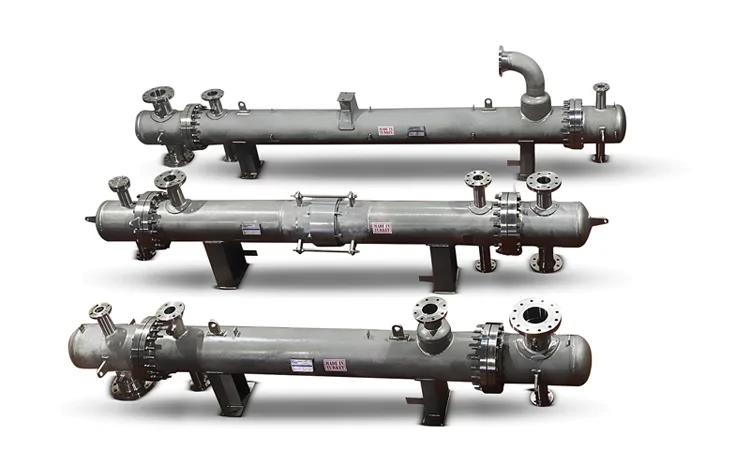
Shell & tube heat exchangers have a design that essentially consists of tube bundles located inside a shell. This special structure allows two fluids that should not mix to transfer only heat energy safely. The working principle is quite clear but equally effective: while the first fluid passes through thin tubes, the second fluid circulates inside the shell, coming into contact with the outer surface of the tubes. At these contact points, natural energy transfer occurs due to the temperature difference, and thus the system operates efficiently.
The large surface area provided by the tubes directly increases the efficiency of heat transfer. The more tubes and surface area there are, the more heat energy can be transferred. For this reason, shell & tube heat exchangers are one of the main solutions preferred in industrial applications where there are high flow fluids and large amounts of energy need to be transferred. Additionally, the ability of fluids to operate safely even under different pressure and temperature conditions demonstrates the durability and reliability of these devices. Thick tube walls that can withstand high pressure and options for stainless steel or alloy materials that can be used against aggressive fluids make them capable of operating smoothly even in the most challenging processes.
One of the most important advantages of shell & tube heat exchangers is their flexible design options. Depending on the need, U-tube, straight tube, or multi-pass arrangements can be used. For example, U-tube designs are preferred especially in processes where thermal expansions are intense and temperature differences are high; while multi-pass designs increase efficiency by extending the heat transfer time of the fluids. Thanks to this diversity, shell & tube heat exchangers can be customized according to special needs in many different sectors, from petrochemical plants to power plants, from the food industry to ship machinery.
The seemingly simple but powerful engineering logic of shell & tube heat exchangers has made them one of the most reliable and widely used technologies in industrial heat transfer.
Advantages of Shell & Tube Heat Exchangers
There are numerous engineering advantages behind the preference for shell & tube heat exchangers:
High Pressure and Temperature Resistance
One of the most notable features of shell & tube heat exchangers is their exceptional durability under challenging working conditions. Even standard designs are produced to operate safely at high temperatures approaching 400 °C and pressures above 40 bar. This resistance makes them indispensable not only in ordinary industrial applications but also in critical energy production facilities, petrochemical refineries, heavy industry operations, and high-risk processes.
High temperature resistance is particularly important in energy-intensive processes such as steam boilers, gas turbines, and thermal power plants. In these areas, fluids continuously circulate at high temperatures, and the slightest weakness in the equipment can lead to serious production losses or safety risks. Shell & tube heat exchangers show superior tolerance to thermal expansion thanks to the quality of the materials used (such as stainless steel, titanium, copper alloys) and special manufacturing techniques. Thus, even at high temperatures, there is no deformation or leakage problem in the shell and tube bundles.
Similarly, high pressure resistance is a critical advantage, especially in the petrochemical industry and natural gas processing facilities. In these facilities, fluids are mostly transported under high pressure, and the durability of the exchanger used is directly related to operational safety. Shell & tube heat exchangers exhibit reliable performance even in sudden pressure fluctuations thanks to their thick-walled tube structure and robust shell design. Additionally, in multi-pass arrangements, the pressure distribution of the fluid is managed in a controlled manner, which extends the equipment's lifespan.
In short, the high pressure and temperature resistance of shell & tube heat exchangers elevates them from being ordinary equipment to strategic technology. This feature ensures not only the safety of businesses but also their continuity. This is why shell & tube heat exchangers are irreplaceable in industries where energy, efficiency, and reliability need to be kept at the highest level.
Flexible Design Opportunities
One of the biggest advantages of shell & tube heat exchangers is that their designs can be completely adapted to process needs. The performance of an exchanger is shaped not only by the basic shell structure but also directly by the length, diameter, material of the tubes, and the number of passes of the fluid. This feature makes them extremely flexible in producing solutions specific to each sector.
For example, when the tube length is increased, the heat transfer surface expands, and a higher heat exchange capacity is achieved. This situation plays a critical role especially in applications where large volumes of fluids need to be cooled or heated. Shorter tubes, on the other hand, are preferred in compact designs, allowing space savings in facilities with limited space.
The tube diameter is also determined according to process requirements. Large diameter tubes allow higher flow rate fluids to be easily transferred, while small diameter tubes provide more controlled and efficient heat transfer. Especially for viscous fluids or liquids containing particles, the appropriate diameter selection is crucial to prevent blockages.
Material selection is entirely dependent on the chemical properties of the fluid and working conditions. Carbon steel stands out with its cost advantage, while stainless steel is frequently preferred in the food, pharmaceutical, and chemical industries due to its corrosion resistance. Special alloys like titanium offer long-lasting solutions in high salinity seawater applications. Thus, the unique needs of each sector can be met.
Finally, the number of passes can also be customized. Single-pass arrangements are sufficient for simple applications, while multi-pass designs provide higher performance by increasing heat transfer efficiency. This flexibility offers optimal solutions in both power plants and food processing facilities.
In short, the flexibility of parameters such as tube length, diameter, material, and the number of passes elevates shell & tube heat exchangers from being standard equipment to "custom engineering products" suitable for the needs of every sector.
Easy Maintenance and Cleaning
One of the main reasons why shell & tube heat exchangers are so widely preferred in the industry is their practicality in maintenance and cleaning processes. Especially in industrial facilities where long-term and uninterrupted production is mandatory, shortening maintenance times directly affects operational efficiency. Thanks to removable tube bundles and flanged structures, easy access to the inner surfaces of the exchangers is provided. This allows both mechanical cleaning processes and chemical washing applications to be carried out quickly and effectively.
One of the biggest problems that tubes face over time is scaling, sediment accumulation, or chemical residues depending on the structure of the fluid. These accumulations reduce heat transfer efficiency and increase energy consumption. However, removable tube bundles allow for easy cleaning of such accumulations. When necessary, only the tube bundle can be removed for maintenance, speeding up the process without the need to dismantle the entire exchanger.
The flanged design is another element that enhances maintenance ease. Thanks to flange connections, certain parts of the exchanger can be easily opened and closed. Thus, both the inspection of inner surfaces and the replacement of spare parts can be carried out quickly. This situation provides a critical advantage, especially in heavy industry and petrochemical sectors, where long downtimes can bring significant costs to the operation.
Additionally, shell & tube heat exchangers are quite flexible in terms of cleaning methods. While chemical cleaning can be performed with CIP (Clean in Place) systems, methods such as mechanical brushing and high-pressure water washing can also be easily applied. This ensures solutions that meet the hygiene and cleaning standards of different sectors.
The modular and accessible design of shell & tube heat exchangers means not only efficient heat transfer for businesses but also low maintenance costs and the assurance of uninterrupted production.
Long-Lasting Use
One of the most important advantages of shell & tube heat exchangers is that they offer reliable performance for many years thanks to their robust material structures. High-strength metals such as stainless steel, titanium, and copper-nickel alloys are generally preferred in the production of these devices. These materials not only provide resistance to high temperatures and pressure but also extend their lifespan even in challenging process conditions thanks to their corrosion resistance.
Many of the fluids used in industrial facilities have aggressive properties that can be acidic, basic, or contain high levels of salt. For example, in cooling systems that work with seawater, the tubes are constantly exposed to the corrosive effects of saltwater. At this point, copper-nickel alloys and titanium tubes provide excellent resistance to seawater corrosion, ensuring the equipment operates smoothly for years. Similarly, stainless steel tubes used in chemical processes show resistance to corrosive substances such as acids and solvents.
Another reason for long-lasting use is the modular and maintenance-friendly design of shell & tube heat exchangers. Tube bundles can be replaced with new ones when necessary, surfaces can be easily cleaned, and thus the device's initial efficiency is maintained. When regular cleaning and appropriate maintenance procedures are applied, the service life of shell & tube heat exchangers can reach 20-30 years. This makes them not just a short-term solution but a long-term investment.
Additionally, the mechanical strength of these devices is one of the fundamental factors of their longevity. In energy plants, petrochemical facilities, or refineries operating under high pressure, the structural integrity of shell & tube heat exchangers is not easily compromised. Their tolerance to thermal expansion against high temperature changes minimizes material fatigue.
Supported by correct material selection, appropriate engineering design, and regular maintenance applications, shell & tube heat exchangers offer businesses safe, efficient, and economical solutions for many years. Therefore, in all sectors where uninterrupted operation of critical processes is mandatory, shell & tube heat exchangers have become a symbol of long-term investment.
Energy Efficiency
One of the most striking features of shell & tube heat exchangers is their ability to provide high energy efficiency. This efficiency is largely achieved thanks to the large surface area offered by the tubes. The basic principle in heat transfer is for hot and cold fluids to transfer heat energy over as much contact surface as possible. In shell & tube heat exchangers, a very large surface area is obtained because one of the fluids circulates inside the tubes and the other outside. This allows maximum heat transfer with minimum energy expenditure.
Energy efficiency is not just a theoretical advantage but a gain directly felt in the costs of businesses. For example, a shell & tube heat exchanger used in a power plant allows waste heat to be recovered and reintegrated into the system. Thus, fuel consumption decreases, which directly reduces energy costs. Similarly, in the chemical and petrochemical sectors, shell & tube heat exchangers make it possible for the heat released during the process to be used in another operation. Such energy recovery applications are critical not only economically but also in terms of environmental sustainability.
Another factor in the energy efficiency provided by shell & tube heat exchangers is the ability to induce turbulent flow in the fluids. Turbulent flow allows the fluid to make more effective contact with the surface and increases the heat transfer coefficient. This allows higher heat transfer with a smaller exchanger. As a result, facilities face lower equipment costs and achieve lower energy consumption during operation.
Additionally, the customizable design of shell & tube heat exchangers also contributes to energy efficiency. By optimizing the length, diameter, material of the tubes, and the number of passes according to process needs, the most suitable heat transfer performance can be achieved for each system. This makes the highest energy savings possible in different sectors, with different fluid and temperature conditions.
Shell & tube heat exchangers are not just devices that regulate the temperature of fluids, but also a strategic part of energy management. Thanks to these devices, businesses are both reducing their costs and fulfilling their responsibilities to the environment by using energy resources more efficiently. In the long term, the energy efficiency provided by shell & tube heat exchangers is one of the most important factors that increase the competitiveness of businesses and support sustainable growth.
Areas of Use in Industry
Chemical and Petrochemical
The chemical and petrochemical industries are areas where the most challenging processes occur, working with both high temperatures and corrosive fluids. Therefore, the durability, reliability, and long-lasting performance of the equipment used are of vital importance. Shell & tube heat exchangers stand out as one of the most suitable solutions for these requirements. Thanks to the shell-tube design, it is possible for fluids with different properties to transfer only heat energy without mixing. This situation allows the highest level of safety, especially in processes involving hazardous and volatile chemicals.
Hydrocarbons processed in petrochemical facilities are generally found under high pressure and temperature. Shell & tube heat exchangers can operate safely even at pressures above 40 bar and temperatures approaching 400 °C. This ensures uninterrupted service in critical processes such as crude oil processing, gas separation, catalytic cracking, and refinery operations. Additionally, thanks to high heat-resistant material options (stainless steel, titanium, copper-nickel alloys), they show resistance to corrosion and provide reliable use for many years.
In the chemical industry, acids, bases, solvents, and various reactive substances are used. Such corrosive fluids, when the wrong equipment is selected, reduce the equipment's lifespan in a short time and pose serious safety risks. Shell & tube heat exchangers adapt to these challenging conditions with tube materials and coatings that can be customized according to chemical properties. For example, titanium tubes offer maximum protection against high salinity in cooling systems using seawater, while special alloys show superior resistance to solvents and acidic solutions.
Energy recovery is also an important advantage of shell & tube heat exchangers in chemical and petrochemical facilities. High-temperature fluids released during the process can be reused by transferring heat to another fluid through shell & tube heat exchangers. This situation significantly reduces energy costs and supports environmental sustainability by reducing carbon emissions.
Shell & tube heat exchangers are not only a heat transfer equipment in the chemical and petrochemical sectors but also the guarantor of safety, energy efficiency, and process continuity. With these features, they increase the competitiveness of industrial facilities while offering long-term and sustainable solutions.
Power Plants
Power plants, whether using fossil fuels or renewable energy sources, are facilities where heat transfer is one of the most critical processes. The basic principle in electricity generation is to use heat obtained from an energy source to produce steam, which then turns turbines to generate electricity. At this point, shell & tube heat exchangers play an indispensable role in both steam production and system cooling.
Maintaining the correct temperature and pressure values of the high-temperature steam produced in boilers is critical for the efficient operation of the plant. Shell & tube heat exchangers perform controlled heat transfer of high-pressure steam thanks to their large surface area. Their structures, which can withstand pressures above 40 bar and temperatures approaching 400 °C, make these devices reliable even in the most challenging conditions of power plants.
Turbine cooling systems are another vital component of power plants. Overheating of turbine blades can lead to both efficiency loss and serious malfunctions. Shell & tube heat exchangers extend the equipment's lifespan and ensure continuity in energy production by keeping the turbine cooling water at the desired temperature. This feature directly contributes to keeping operating costs under control, especially in large-scale thermal and natural gas cycle power plants.
Waste heat recovery systems play a critical role in increasing energy efficiency. High-temperature exhaust gases or waste steam released from plant processes are reevaluated by transferring heat to different fluids through shell & tube heat exchangers. Thus, both fuel consumption decreases and environmental emissions are reduced. This feature is of great importance for power plants working with the goal of reducing their carbon footprint today.
Additionally, in nuclear power plants, shell & tube heat exchangers have a critical role in terms of safety. Controlled transfer of the heat produced in reactors is a fundamental condition for the safe operation of the reactor. The high resistance strength of shell & tube heat exchangers guarantees reliability in these challenging applications.
Food and Beverage Industry
The food and beverage sector is one of the areas where hygiene and product quality must be kept at the highest level. Therefore, every piece of equipment used must be not only efficient but also fully compliant with food safety standards. Shell & tube heat exchangers have become one of the most reliable solutions in the sector due to their durability, wide material options, and high heat transfer capacity.
In applications such as pasteurization, milk processing, juice production, beer, and wine cooling, it is a critical requirement to provide heat transfer while preserving the taste, aroma, and nutritional value of the product. The production of shell & tube heat exchangers from food-grade materials such as stainless steel, titanium, or copper-nickel increases corrosion resistance and guarantees hygiene standards. This ensures that the risk of contamination or taste change is minimized when processing sensitive products like milk or juice.
For example, in milk processing plants, during the pasteurization process, milk needs to be heated to a certain temperature and then quickly cooled. Shell & tube heat exchangers perform this process quickly and controlled thanks to their large heat transfer surfaces. This ensures the preservation of product quality and contributes to operating costs by reducing energy consumption.
In beer and wine production, controlling fermentation temperatures is of great importance. Shell & tube heat exchangers help manage heat transfer between the cooling water and the product precisely, ensuring fermentation occurs under the right conditions. This directly affects the flavor profile of the final product and provides manufacturers with the opportunity to maintain standard quality.
Additionally, in terms of the frequent cleaning and hygiene requirements encountered in the food sector, shell & tube heat exchangers offer a great advantage. Thanks to removable tube bundles, they can be easily cleaned with CIP (Cleaning in Place) and SIP (Sterilization in Place) systems. This feature ensures the uninterrupted operation of production lines while also fully meeting hygiene requirements.
Shell & tube heat exchangers used in juice production control the temperature of the fruit puree or liquid, extending the shelf life of the product while preserving freshness and nutritional values. At the same time, they contribute to the optimization of energy used in the production process, offering both economic and environmental benefits.
Metallurgy and Mining
The metallurgy and mining sector is one of the industrial areas where high temperatures, intense pressures, and abrasive fluids are most intensely observed. Therefore, the equipment used must not only be durable but also offer long-term and reliable performance. Shell & tube heat exchangers have become one of the solutions that meet the sector's most critical needs with their high heat-resistant structures and customizable designs.
During smelting processes, metal alloys need to be heated at high temperatures and then cooled in a controlled manner. At this point, shell & tube heat exchangers can be used safely thanks to their ability to withstand temperatures up to 400 °C. Their ability to perform efficient heat transfer even under high temperature conditions ensures that the production process progresses both safely and energy-efficiently. Additionally, models produced using stainless steel, titanium, or special alloys offer long-term durability in environments where they come into contact with aggressive gases and chemical fluids.
In the mining field, the management of dense muddy fluids, particle-laden waters, and high-pressure environments is required. The large internal volume and strong mechanical strength of shell & tube heat exchangers provide a great advantage in processing these types of challenging fluids. Even fluids carrying abrasive minerals can be safely managed thanks to specially alloyed tubes, thus extending the equipment's lifespan and reducing maintenance costs.
Additionally, shell & tube heat exchangers play a strategic role in waste heat recovery, which is frequently needed in mining processes. The heat of high-temperature gases or fluids released from ore processing and smelting furnaces can be recovered and reused in other parts of the facility. This not only increases energy efficiency but also contributes to environmental sustainability goals.
HVAC and Heating Systems
Shell & tube heat exchangers are among the most preferred solutions in HVAC (Heating, Ventilation, and Air Conditioning) and heating applications. They offer a wide range of uses, from central heating systems to large-scale cooling towers, from pool heating applications to district heating networks. Especially in high-capacity facilities, they provide uninterrupted service thanks to their long-lasting and reliable structures.
In central heating systems, shell & tube heat exchangers enable the efficient distribution of hot water or steam and the maintenance of a constant temperature in different parts of buildings. These devices can be safely used in large residential complexes, hotels, and shopping centers thanks to their high pressure and temperature resistance. At the same time, they can be easily adapted to different capacity needs with their customizable designs.
On the cooling tower side, they safely and efficiently manage the circulation of hot water in the facility. The large heat transfer surface offered by shell & tube heat exchangers in heavily working cooling systems allows water to be cooled faster and more effectively. This contributes to both reducing energy costs and extending equipment lifespan.
In pool heating applications, shell & tube heat exchangers operate with high efficiency, especially in large swimming pools and spa centers. While ensuring that the pool water is maintained at the desired temperature, they also maintain hygiene standards. Stainless steel or titanium material options provide extra durability against corrosive environments such as chlorinated or salty water.
Another important advantage of shell & tube heat exchangers in HVAC and heating systems is their effectiveness in energy recovery. By making it possible to reevaluate waste heat, they contribute to environmental sustainability and create significant cost advantages for businesses in the long term.
The Importance of Material Selection
The materials used in shell & tube heat exchangers directly determine the lifespan and performance of the device.
• AISI 316L Stainless Steel: It is the standard solution in sectors where chemical resistance and hygiene are required.
• Titanium: Resistant to high chlorine and acidic environments, it is especially preferred in seawater applications.
• Copper-Nickel Alloys: Provides long life in saltwater cooling systems.
• Carbon Steel: Offers high strength and cost advantage.
Correct material selection guarantees the device's trouble-free operation for years.
The Role of Shell & Tube Heat Exchangers in Sustainability
Today, energy savings and the reduction of carbon emissions are strategic priorities for all industries. Shell & tube heat exchangers play a critical role in areas such as waste heat recovery, renewable energy projects, and efficient energy management.
Their increasing preference in data centers, electric vehicle battery cooling systems, and geothermal energy projects will further increase their importance in the future.
Solutions of Ekin Industrial
As Ekin Industrial, we produce high-quality shell & tube heat exchangers and meticulously carry out every step from engineering calculations to material selection. Each of our products is designed to meet the special needs of different sectors and undergoes tests in accordance with international quality standards.
The solutions we offer to our customers not only help them achieve today's energy efficiency and sustainability goals but also those of the future.
Conclusion: The Key to a Strategic Investment
Shell & tube heat exchangers stand out as one of the most reliable elements of industrial heat transfer technologies with their high durability, long lifespan, and wide range of use. They are not just a machine part or auxiliary equipment; they are a strategic investment that directly affects the sustainability of production processes, operational safety, and energy efficiency.
Considering that even a few hours of downtime in industrial facilities can lead to losses worth millions of liras, the reliability offered by shell & tube heat exchangers is a critical advantage for businesses. Thanks to their structures that can withstand high pressure and temperature, they show stable performance even in the most challenging processes. Additionally, the ease of maintenance and cleaning ensures production continuity by reducing maintenance costs for businesses.
Shell & tube heat exchangers not only meet today's production needs but also serve the future's energy management and environmental sustainability goals. Their ability to recover energy, reevaluate waste heat, and offer maximum efficiency with minimum energy expenditure makes them a technology that directly contributes to reducing carbon emissions. In this respect, they become a strategic choice for every business that wants to adapt to the increasing sustainability pressure on a global scale.
As Ekin Industrial, with our years of engineering experience and high-quality standards, we confidently meet not only today's needs but also tomorrow's expectations with our shell & tube heat exchanger solutions. By offering design and material options suitable for the specific requirements of each sector, we provide our customers with maximum performance and long-term investment value.
In conclusion, shell & tube heat exchangers are not just ordinary devices used for heat transfer; they are the fundamental keys to efficiency, reliability, and sustainability. For your business to progress with solid steps into the future and increase its competitive power, shell & tube heat exchanger technologies will continue to be one of the best choices.