It is a known fact that in industrial fluid transfer systems, not every process operates under the same conditions. While clean water or low-viscosity liquids are transported in some applications, other lines contain dense sludge, fibrous fluids, or mixtures with a high amount of abrasive particles. These types of challenging fluids create a serious abrasive and clogging effect on all equipment, from pipelines to pumps and valve systems. Especially standard gate valves, ball valves, or butterfly valves can quickly lose performance in such environments. Deteriorations on sealing surfaces, blockages due to fluid accumulation inside, and rapid wear on the valve body weaken system reliability. This situation not only shortens the equipment's lifespan but also endangers the overall safety and efficiency of the operation.
These conditions, where challenging fluids are present, require specially designed and durable solutions. This is exactly where knife gate valves come into play, distinguishing themselves from other valve types thanks to their unique design. These valves, which open and close the flow path with a sharp blade moving vertically, allow safe control of the line, especially in fluids with high particle content or fibrous nature. The blade structure easily cuts through and progresses the solid materials accumulated in the fluid, preventing the line from clogging. Thus, the opening and closing function of the valve is not hindered by jamming or accumulation problems seen in standard valves.
Another important advantage of knife gate valves is their long-lasting use under heavy conditions. Thanks to their one-piece body structure, strong sealing elements, and stainless steel blades, they are suitable for working with both abrasive and chemically aggressive fluids. As a result, they have become a trusted solution for businesses in many sectors, from wastewater facilities to the paper industry, mining to the chemical industry.
In short, in environments where standard valves are inadequate and where fluids loaded with sludge, particles, and fibers need to be safely controlled, knife gate valves come into play, ensuring the process operates safely, efficiently, and uninterruptedly. They stand out as indispensable equipment for both process safety and operational continuity.
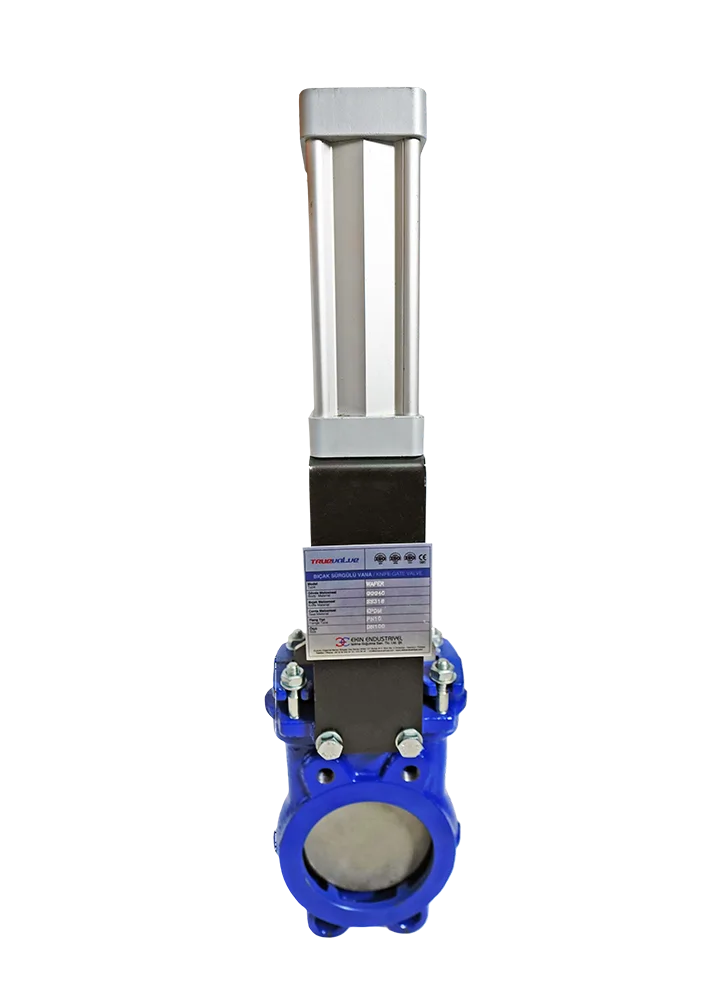
Knife gate valves derive their name from a thin and flat gate mechanism that cuts the fluid path. This gate moves vertically along the flow line and closes between two sealing rings in the valve body, providing complete isolation. Thus, no matter how challenging the fluid in the line is, it can be reliably stopped or released. Due to their operating principles, knife gate valves are generally used in fully open or fully closed positions; they are not suitable for flow control in partial openings. The main reason for this is that the gate is designed to clearly cut and open the passage of the fluid rather than regulate the flow precisely.
Thanks to these features, knife gate valves are indispensable in systems where muddy, fibrous, dense, or particle-laden fluids are managed. In the paper industry, pulp with high fiber content often causes blockages in standard gate valves, while knife gate valves ensure the continuity of flow by easily cutting the fibers with their cutting structures. In wastewater treatment facilities, sewage sludge and solid particles are safely managed thanks to the strong closing feature of knife gate valves.
Mining and mineral processing facilities are another area where knife gate valves stand out. High-density sludges, abrasive minerals, and challenging process conditions can cause standard valves to wear out quickly. However, knife gate valves offer a long-lasting solution in these environments thanks to their stainless steel blade designs and wear-resistant body structures.
Additionally, in the chemical industry, they can be used with special alloy bodies and PTFE-coated sealing options for the safe control of corrosive and aggressive fluids. In the food sector, they provide hygienic and reliable flow management in the transfer of dense mixtures, fruit pulps, or by-products. Thus, knife gate valves stand out not only as a valve but as strategic equipment that guarantees continuity, safety, and efficiency in industrial processes.
Applications and Industrial Importance
The paper and pulp industry is one of the leading sectors where knife gate valves stand out. The pulp used in paper production contains a high amount of fiber, and this fibrous structure can easily cause blockages in standard gate or butterfly valves. Fibers accumulate on the gate surface, preventing closure or not allowing the valve to fully open. This situation disrupts the flow balance of the process and increases energy consumption. The most notable advantage of knife gate valves is that they ensure the continuity of flow by easily splitting or cutting these fibers with their cutting gate structure. Thus, there is no interruption in the production line, and valves can operate for a long time without requiring maintenance. This feature is of great importance for the continuity of businesses in sectors like the paper and pulp industry, which require continuous production.
Wastewater treatment facilities are also among the areas where knife gate valves are widely preferred. Sewer lines, industrial wastewater lines, and pipe systems carrying biological sludge contain a high amount of solid particles, fibrous waste, sand, gravel, or organic matter. These types of fluids cause sealing problems, mechanical failures, and blockages in standard valves. Knife gate valves guarantee the closing or opening of the line by passing through such solid materials with their strong and cutting gates. Additionally, their complete sealing closure features prevent wastewater from leaking outside, thus ensuring both environmental safety and hygiene in operating facilities. Especially in biological sludge lines, the uninterrupted operation of the valve is a critical factor for plant efficiency.
Mining and mineral processing facilities are environments that test the performance of knife gate valves in the most challenging way. The fluids transported here mostly consist of abrasive high-density sludges, mineral particles, and high-density mixtures. These types of fluids can cause very rapid wear on the valve body and gate surfaces. However, knife gate valves are developed to withstand these harsh conditions thanks to their cutting blades made of stainless steel and wear-resistant body designs. When necessary, bodies are manufactured from special alloys or coatings to extend their lifespan. Thus, reliable control of lines in mining processes is ensured, and maintenance and downtime are minimized.
The chemical industry is also one of the critical areas where knife gate valves are frequently used. This sector often works with aggressive fluids, corrosive chemicals, or mixtures containing particles. Due to the nature of chemicals, standard valves can quickly corrode, seals can deteriorate, and lose their sealing properties. Knife gate valves are produced with special alloy bodies, PTFE-coated sealing elements, and materials with enhanced chemical resistance in such processes. This ensures both process safety and extends the equipment's lifespan. Additionally, since many fluids in the chemical industry have high temperatures, knife gate valves with heat-resistant elastomer seats or metal-seated models are preferred to achieve safe use.
The food industry also holds an important place among the application areas of knife gate valves. The fluids encountered in food production can sometimes be high-viscosity dense mixtures, sometimes fruit pulps, sugar syrup, or production by-products. The safe transportation of these types of fluids is of critical importance in terms of both hygiene standards and production quality. When knife gate valves are produced with body and sealing materials suitable for hygienic standards, they can be used seamlessly in food facilities. Especially in intensive production lines such as fruit juice, confectionery, and bakery products, the cutting structure of knife gate valves allows pulps or thick products to be transferred without clogging the line. Thus, safe and efficient flow control is achieved in the food sector.
From paper to wastewater, mining to chemicals, and food, knife gate valves stand out as one of the most reliable valve types that can handle difficult fluids. In all environments with fibrous, dense, particulate, or abrasive fluids, the uninterrupted flow, complete sealing, and long-lasting performance provided by knife gate valves offer an indispensable advantage for businesses.
Structural Features and Material Options
One of the most important reasons why knife gate valves are so widely preferred in the industry is their simple yet extremely robust structures. The valve body is mostly designed as a single piece. This structure not only provides ease during assembly but also minimizes potential leak points. Especially when working under high pressure or with challenging fluids, the integrity offered by the one-piece body plays a critical role in the system's long-term reliability. Additionally, the compact structure of the body allows knife gate valves to be installed seamlessly even in narrow spaces.
Sealing elements are another factor that directly affects the performance of knife gate valves. These seals, mostly made from elastomer-based materials (EPDM, NBR, NR), offer solutions compatible with fluids having different chemical properties. For example, EPDM shows durability in high-temperature and steam lines, while NBR provides resistance to oils and hydrocarbon-based fluids. Natural rubber (NR) stands out especially in particulate fluids due to its abrasion resistance. However, in environments where the process has much more challenging conditions—such as high temperature, dense abrasive particles, or aggressive chemicals—metal-seated sealing is preferred instead of elastomer. Metal-seated designs extend the valve's lifespan and reduce maintenance frequency, especially in heavy processes requiring complete sealing.
The body materials of knife gate valves also vary according to the application area. Stainless steel (AISI 304, AISI 316) bodies are indispensable in processes where chemical resistance is critical. Especially AISI 316, with its molybdenum content, offers superior corrosion resistance against chlorinated environments. This feature makes it preferred in environments where seawater lines, the chemical industry, or hygiene conditions need to be maintained in food production. For businesses seeking a more economical and robust solution, GGG40 ductile iron bodies are an ideal balance. Ductile iron offers long-term safe use in abrasive sludge lines thanks to its high impact resistance and strength.
The blade part, which is one of the most critical components of the valve, is almost always made of stainless steel. Because this blade, which acts as a gate, is directly exposed to the pressure of the fluid, the abrasive effect of particles, and possible chemical reactions. Stainless steel prevents the fluid from sticking or accumulating thanks to its corrosion-resistant structure and surface smoothness. This is critically important for the uninterrupted continuation of flow, especially in fibrous fluids.
When examining technical data, it is seen that knife gate valves offer a wide operating range. Standard models can be used safely at temperatures up to 150 °C. This value is sufficient for applications involving high temperatures such as rubber molding, steam lines, or chemical processes. In models with special alloys or PTFE coatings, temperature resistance can be further increased. In terms of operating pressure, knife gate valves are generally designed to work smoothly up to 16 bar. This pressure value is ideal for many industrial processes—especially in wastewater, sludge transfer, chemical fluids, and food production lines. For special applications requiring higher pressure, models with increased body and blade thicknesses are preferred.
The modular structure and material diversity of knife gate valves make them adaptable to almost any application. When a facility needs corrosion resistance, stainless steel bodies come into play, while ductile iron bodies or special alloys are used when high wear resistance is required. Similarly, long-lasting and reliable use is ensured by choosing elastomer or metal-seated sealing elements according to the chemical structure of the fluid.
Operating Methods and Automation Options
One of the most important advantages of knife gate valves is that they offer flexible operating options according to different operating conditions and needs. Taking into account parameters such as valve size, line pressure, fluid properties, and the system's level of automation, knife gate valves can be equipped with manual or automatic control mechanisms. Thus, they offer reliable and long-lasting solutions in both small-scale and large-scale facilities.
The most basic control method is manual wheel operation. Wheel-operated knife gate valves are generally preferred in low-diameter lines, relatively low-pressure applications, and simple operating conditions. The operating personnel turns the wheel to raise or lower the blade and open or close the line. This method stands out with its low cost and ease of use. However, as the line diameter increases and the fluid pressure increases, manual operation becomes difficult; higher torque needs come into play. In such cases, gear box designs are used. The gear box strengthens the rotation of the wheel with mechanical advantage, making it easier to open and close the blade. Thus, even in large-diameter and high-pressure lines, the operator does not need to exert much effort. Similarly, chain wheel solutions provide practicality when the valve is located in hard-to-reach points; the operator can control the valve from a safe distance via the chain.
Manual control methods may be sufficient, especially in facilities with low automation levels and low-critical applications. However, the increasing importance of automation in the industry today has made it mandatory for knife gate valves to be equipped with modern actuators. At this point, pneumatic piston actuators come into play. Pneumatic actuators operate with compressed air energy and ensure that knife gate valves open and close quickly, powerfully, and reliably. Pneumatic actuators offer a great advantage, especially when emergency shutdown (safety valve function) is required in processes. Pistons that produce direct linear motion with air pressure provide an effective solution even in large-diameter and high-torque requiring valves. Additionally, pneumatic actuators are simple in terms of maintenance; they can operate safely for many years thanks to their compact structure.
Another modern solution is electric motor actuators. Electric actuators derive their energy from electricity and are generally preferred in applications requiring precise control. Because these actuators not only offer an open-close function but also provide the possibility of step-by-step control. Especially when integrated with central control systems (SCADA, DCS, etc.), operators can see the position of the valves in real-time and make adjustments at certain angles when necessary. This feature facilitates process optimization in production lines and minimizes the need for human intervention. Electric actuators also offer an alternative to pneumatic solutions in environments where there is no air supply.
With the development of automation systems, actuators integrated into knife gate valves not only include opening-closing functions but also feedback and monitoring features. Thanks to limit switch boxes, position sensors, and torque measurement systems, the valve position can be continuously monitored. This ensures that malfunctions are detected in advance, especially in critical processes, and unplanned shutdowns are prevented.
In critical processes, the quick and reliable opening and closing of knife gate valves provide a vital advantage in terms of operational safety. For example, when a malfunction occurs in lines carrying corrosive fluids in the chemical industry, the line can be safely isolated in a very short time thanks to the knife gate valve with pneumatic or electric actuators. Similarly, in wastewater treatment facilities or mining processes, remotely controlled valves in lines carrying dense sludges increase both work safety and reduce maintenance costs.
The operating methods of knife gate valves are offered in a wide range from manual to full automation. While wheel or gear box manual operation is sufficient in small-scale applications, solutions integrated with automation with pneumatic and electric actuators are preferred in modern industrial facilities. Thus, knife gate valves are not just a simple valve, but become strategic equipment that increases the overall efficiency and safety of the operation.
Why Choose a Knife Gate Valve?
One of the most important reasons for choosing knife gate valves is their reliable performance even in challenging fluid conditions. Standard valves can quickly wear out, clog, or lose their sealing when working with muddy, fibrous, or high particle density fluids. However, the specially designed cutting gate mechanism of knife gate valves prevents these types of fluids from clogging the line. The particles in the fluid are easily cut by the blade, allowing passage, and the valve sits in its seat to provide complete sealing with each open-close cycle. This feature makes knife gate valves unrivaled, especially in challenging environments such as wastewater treatment, pulp processing, mining sludges, or chemical processes.
Another critical advantage is sealing reliability. Knife gate valves can work safely even at high pressure or with corrosive fluids by being equipped with elastomer or metal-seated sealing elements according to the process needs. Especially in wastewater or biological sludge lines, this complete closure feature that prevents bad odors and harmful fluids from leaking outside provides an important advantage in terms of both environmental safety and worker health.
Ease of maintenance and low operating costs are also among the prominent advantages of knife gate valves. Thanks to their modular body structure, valve parts can be easily disassembled and reassembled. This allows businesses to make necessary changes on the valve within a short time without experiencing long maintenance downtimes. The replacement of sealing elements is usually carried out with simple procedures, and the valve can be put back into service. Additionally, actuator systems—manual, pneumatic, or electric—can be added or changed later according to need. Thus, a single valve body can serve the business for many years by adapting to different control systems.
Another important advantage provided by knife gate valves is long-lasting use and durability. Blades made of stainless steel and robust cast bodies show high resistance against abrasive minerals or corrosive chemicals. This durability not only reduces failures but also contributes to extending planned maintenance intervals. Fewer failures and maintenance mean directly reduced operating costs.
Additionally, knife gate valves are also noteworthy in terms of operational flexibility. While manual control mechanisms offer a low-cost solution in small-scale facilities, they can be integrated into modern automation systems thanks to pneumatic and electric actuator options. This feature increases the value of the investment in both existing facilities and new projects. A business can reconfigure the knife gate valve as its needs change; a valve that starts with manual operation can be integrated into automation in the future, adapting to different scenarios.
Choosing a knife gate valve does not only mean acquiring a valve that can work smoothly under challenging fluid conditions. It also means providing the business with an economical, reliable, maintenance-friendly, and automation-ready solution in the long term. This makes knife gate valves a strategic investment for operational safety and continuity in modern industrial facilities.
Conclusion: Reliable Valves Resistant to Harsh Conditions
A large portion of the fluids used in industrial facilities has conditions that standard valve types cannot easily handle. Muddy, dense particulate, fibrous, or chemically aggressive fluids can quickly lead to blockages in the system, wear on the valve body, and significant operational losses. At this point, knife gate valves come into play with their special designs and durable structures, offering a reliable solution even under the harshest conditions.
The most striking advantage of knife gate valves is their complete sealing closure feature. The fibers, solid particles, or abrasive minerals in the fluid are easily eliminated thanks to the cutting gate mechanism. Thus, the valve provides complete isolation with each closure. This feature is of great importance not only in terms of process safety but also in terms of environmental safety. Especially in wastewater lines or chemical processes, preventing fluid leakage outside reduces environmental damage and increases operational safety.
Another important point is the durability and long-lasting performance of knife gate valves. AISI 304 or 316 stainless steel used as the body material offers high resistance to corrosion. Ductile iron (GGG40) options are preferred especially in processes with abrasive sludges due to their high strength. Elastomer-seated valves provide excellent compatibility for water and light chemicals, while metal-seated models work smoothly under high temperature and heavy-duty conditions. This diversity brings the flexibility to offer the most suitable solution for the needs of different industries.
The operating and control options of knife gate valves are also one of the factors that make them stand out. While manual wheel solutions provide low-cost and practical use in small and simple systems, gear box or chain wheel models offer ease in large-diameter lines. In modern industry, knife gate valves with pneumatic or electric actuators are preferred due to the rising role of automation. These solutions offer the possibility of remote control, automatic opening-closing, and integration into central monitoring systems, ensuring businesses operate more safely and efficiently.
As Ekin Industrial, we offer knife gate valve solutions tailored to the needs of every business with a wide product range. Our options with stainless steel and ductile iron bodies, combined with elastomer or metal-seated sealing systems, can be configured in the most suitable way for the conditions required by your process. Whether manual or fully automated solutions, our expert team guides you in the correct valve selection. Thus, we offer a long-term and sustainable solution by considering not only your current needs but also your potential capacity increases and process changes in the future.
In conclusion, knife gate valves are not just a valve but a strategic investment that guarantees continuity under challenging conditions. With reliable closure, low maintenance needs, high material quality, and automation compatibility, knife gate valves are an indispensable part of modern industrial facilities. Ekin Industrial's knife gate valves, produced to high-quality standards, provide long-lasting performance, safety, and efficiency in your systems. This way, while your total cost of ownership decreases, you achieve stability and quality increase in your production processes.