Proper management of liquids in industrial facilities is vital not only for production efficiency but also for product quality, consumer safety, process stability, and compliance with legal regulations. Especially in sectors with sensitive production disciplines such as food, pharmaceuticals, cosmetics, and chemicals, if process equipment does not meet hygiene requirements, encountering serious consequences such as product contamination, production losses, damage to brand reputation, and even legal sanctions is inevitable. Therefore, every piece of equipment used in the production process must not only provide technical performance but also support hygienic safety and long-term sustainability.
At this point, hygienic centrifugal pumps that meet the high hygiene standards required by modern industry come into play. These special pumps not only transfer liquids but also maintain the physical, chemical, and microbiological integrity of the liquid they carry, ensuring the continuity of a sterile and safe environment throughout the process. All components, from the pump body to the fan structure, from the gasket material to the mechanical seal system, are designed with food safety, ease of cleaning, corrosion resistance, and long-lasting performance in mind.
The body and inner surfaces of hygienic centrifugal pumps that come into contact with the liquid are generally made of AISI 316L quality stainless steel. This material shows high resistance to both acidic and neutral liquids and prevents bacteria from adhering with its smooth surface structure. Additionally, the internal design of the pumps is arranged to avoid blind spots, allowing them to work in full harmony with both manual cleaning and automatic CIP/SIP systems. This structure offers a critical advantage for facilities that produce in compliance with international hygiene standards such as ISO 22000, BRC, FDA, EHEDG, and 3A.
These pumps can be designed to be integrated not only on fixed lines but also on mobile platforms. Thus, the same pump can be used at different production points, providing flexible liquid transfer within the facility and achieving space optimization. Fully compatible with automation systems, these pumps can be digitized with sensor-based applications such as speed control, flow monitoring, and temperature tracking. This provides a significant advantage in terms of adapting to Industry 4.0 and data-based production processes.
Hygienic centrifugal pumps serve not only as auxiliary equipment in production lines but also as the heart of the process. They transfer liquid from one point to another without compromising product quality, adapt to fluids with different viscosities and temperatures, increase system efficiency, and save time in cleaning processes. Thanks to their ability to work under vacuum, it becomes possible to transfer sensitive liquids without damage. For example, products such as milk, yogurt, fruit juice, beer, and syrup, which have a very sensitive structure both microbiologically and physically, require the pump used for their transfer to be hygienic.
Today, many manufacturers in the global market consider the selection of hygienic pumps not only as a technical necessity but also as a decision equivalent to corporate responsibility and brand assurance.
Because one of the most important factors affecting the quality of a product is how safe and suitable the equipment used in the production line is.
In this article, we will examine in detail what hygienic centrifugal pumps are, what technical features they have, how they are positioned in different sectors, and the multidimensional contributions they provide to businesses. We will also discuss in detail which criteria should be used to make the right pump selection, how technical data should be evaluated, and the factors to pay attention to for long-term use. Our aim is to support you in making well-informed decisions to achieve maximum hygiene, efficiency, and safety in your production processes.
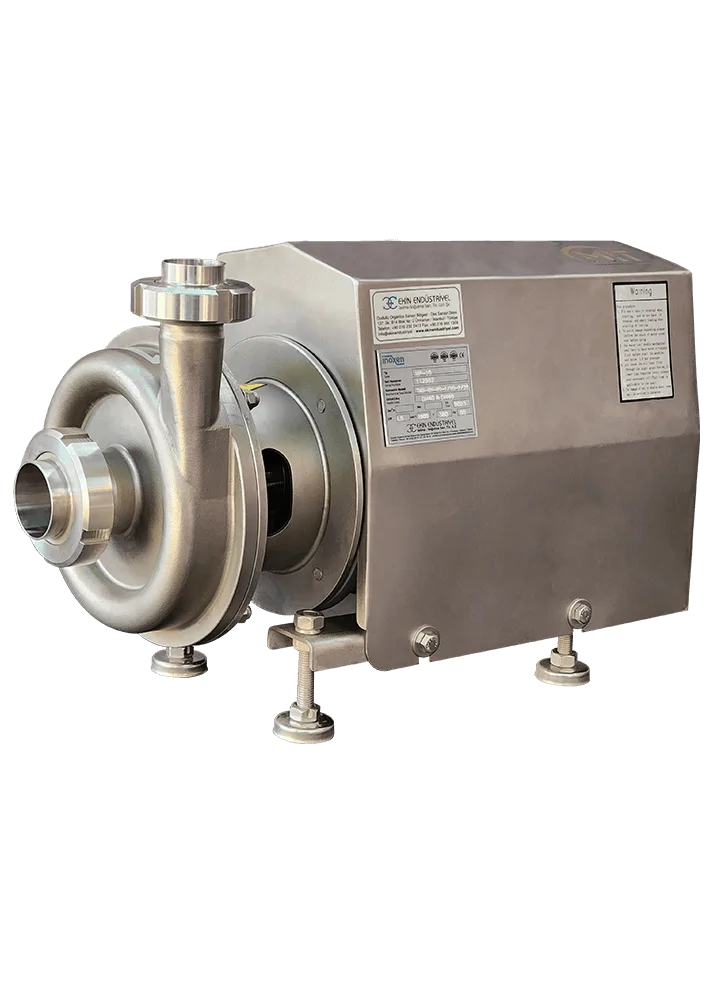
Hygienic centrifugal pumps are specially designed pumps that ensure the safe transfer of liquids without exposure to any microbiological, chemical, or physical contamination. These pumps, which play a critical role especially in the food, beverage, pharmaceutical, cosmetic, and chemical sectors, are indispensable equipment for the sustainability of hygienic production processes. As the name suggests, the main purpose of hygienic centrifugal pumps is to ensure the transfer of liquid in safe and sterile conditions without altering its structure.
These pumps are made from special materials such as stainless steel, which is resistant to corrosion, suitable for contact with food, and has properties that prevent bacterial growth on all surfaces that come into contact with the liquid. AISI 316L quality stainless steel is generally preferred; this material minimizes microorganism adhesion thanks to its chemical resistance and smooth surface. Additionally, surface coatings and design details allow cleaning processes to be easily applied with systems such as CIP (Clean in Place) and SIP (Sterilization in Place).
The design of hygienic centrifugal pumps is not limited to material alone; the internal surface geometry, fan shape, mechanical seal structure, and gaskets are also shaped according to norms prioritizing food safety. Circular cross-section flow channels, a body structure without blind spots, and mechanical seals supported by a water cartridge ensure that the surfaces in contact with the product are ideal in terms of microbiological cleanliness.
In practice, these pumps are often referred to as "stainless milk pumps" because dairy production facilities are one of the areas where these equipment are most intensively used. The use of hygienic pumps is mandatory not only for milk but also in the production of sensitive dairy products such as yogurt, ayran, whey, and cream. In addition, they are safely preferred in beverage industry products such as fruit juices, mineral waters, carbonated drinks, alcoholic beverages, and syrups; as well as in pharmaceutical products such as syrups, liquid medicines, and serum solutions used in drug production.
Another prominent advantage of hygienic centrifugal pumps is their easy disassembly and assembly feature. This feature saves time and labor, especially during production transitions or cleaning processes. The internal parts of the pump can be checked within minutes with operator intervention, and cleaning or maintenance operations can be applied if necessary. This flexibility allows hygiene control to be carried out without disrupting production continuity, especially in businesses with food safety systems such as HACCP and ISO 22000.
In summary, hygienic centrifugal pumps are advanced engineering products that ensure the security of production processes in sectors with high hygiene requirements and enable liquid transfer to be carried out in accordance with both technical and legal requirements. With a design suitable for cleaning, durable material, and reliable performance, they have become one of the most critical components of industrial facilities.
Hygienic centrifugal pumps are specially designed pumps that ensure the safe transfer of liquids without exposure to any microbiological, chemical, or physical contamination. These pumps, which play a critical role especially in the food, beverage, pharmaceutical, cosmetic, and chemical sectors, are indispensable equipment for the sustainability of hygienic production processes. As the name suggests, the main purpose of hygienic centrifugal pumps is to ensure the transfer of liquid in safe and sterile conditions without altering its structure.
These pumps are made from special materials such as stainless steel, which is resistant to corrosion, suitable for contact with food, and has properties that prevent bacterial growth on all surfaces that come into contact with the liquid. AISI 316L quality stainless steel is generally preferred; this material minimizes microorganism adhesion thanks to its chemical resistance and smooth surface. Additionally, surface coatings and design details allow cleaning processes to be easily applied with systems such as CIP (Clean in Place) and SIP (Sterilization in Place).
The design of hygienic centrifugal pumps is not limited to material alone; the internal surface geometry, fan shape, mechanical seal structure, and gaskets are also shaped according to norms prioritizing food safety. Circular cross-section flow channels, a body structure without blind spots, and mechanical seals supported by a water cartridge ensure that the surfaces in contact with the product are ideal in terms of microbiological cleanliness.
In practice, these pumps are often referred to as "stainless milk pumps" because dairy production facilities are one of the areas where these equipment are most intensively used. The use of hygienic pumps is mandatory not only for milk but also in the production of sensitive dairy products such as yogurt, ayran, whey, and cream. In addition, they are safely preferred in beverage industry products such as fruit juices, mineral waters, carbonated drinks, alcoholic beverages, and syrups; as well as in pharmaceutical products such as syrups, liquid medicines, and serum solutions used in drug production.
Another prominent advantage of hygienic centrifugal pumps is their easy disassembly and assembly feature. This feature saves time and labor, especially during production transitions or cleaning processes. The internal parts of the pump can be checked within minutes with operator intervention, and cleaning or maintenance operations can be applied if necessary. This flexibility allows hygiene control to be carried out without disrupting production continuity, especially in businesses with food safety systems such as HACCP and ISO 22000.
In summary, hygienic centrifugal pumps are advanced engineering products that ensure the security of production processes in sectors with high hygiene requirements and enable liquid transfer to be carried out in accordance with both technical and legal requirements. With a design suitable for cleaning, durable material, and reliable performance, they have become one of the most critical components of industrial facilities.
Why Hygienic Centrifugal Pump?
The most important priority of liquid transfer systems used in the food, beverage, pharmaceutical, and cosmetic sectors is to ensure that the product is transported safely and sterile from the initial production point to the final packaging stage without any contamination. For this purpose
hygienic centrifugal pumps, which are preferred, not only perform the transfer of liquids but also guarantee product safety, process hygiene, and full compliance with legal regulations.
Standard centrifugal pumps may be suitable for the transfer of industrial liquids; however, these pumps may be insufficient to meet critical needs such as food safety or pharmaceutical cleanliness requirements. At this point, hygienic centrifugal pumps allow working without compromising quality and safety at every stage of production processes. The main advantages that make the preference of these pumps mandatory can be listed as follows:
• Use of Food-Grade Materials
The body and impellers of hygienic centrifugal pumps are generally made of AISI 316L quality stainless steel, corresponding to EN 1.4404 standards. This material shows high resistance to chemical corrosion and is processed with smoothness that prevents bacterial formation on surfaces in direct contact with food and pharmaceuticals. This ensures that the structure of the product is not altered during liquid transfer, preserving taste, color, and chemical integrity.
• Ability to Operate Under Vacuum
Many production processes occur in vacuum systems. Especially in the transfer of sensitive products such as milk, fruit juice, and serum, pressure control within the system is of great importance. Hygienic centrifugal pumps offer seamless performance in such applications thanks to their special design that can operate effectively even under vacuum. This feature allows the pump to work efficiently with both low-viscosity and sensitive formulation liquids.
• Seal Protection Against Freezing and Excessive Heat
The temperature conditions of the fluid during liquid transfer are an important factor. In some production processes, liquids may occasionally approach the freezing point or exceed 100°C due to CIP/SIP applications. This situation threatens the sealing elements inside the pump. Hygienic centrifugal pumps prevent surface damage that may occur due to freezing thanks to their mechanical seal system with a water cartridge. At the same time, this structure extends the life of the seal and reduces maintenance costs.
• Hygienic Design: Blind Spot-Free and Smooth Structure
Preventing bacterial growth inside the pump requires not leaving blind spots on surfaces. The fan and body design of hygienic pumps is optimized to meet this need. These structures, designed to prevent liquid accumulation on internal surfaces, ensure that every point is accessible during cleaning and sterilization processes. This feature also ensures full compliance with international hygiene standards such as EHEDG (European Hygienic Engineering & Design Group).
• Easy Cleaning and Maintenance: CIP/SIP Compatible Structure
One of the most important advantages of hygienic centrifugal pumps is their easy disassembly and cleanability features. Especially in facilities producing food and pharmaceuticals, equipment needs to be quickly cleaned during product transitions. Thanks to its CIP (Clean in Place) and SIP (Sterilization in
Place) compatible structure, the pump allows internal cleaning without being removed from the system. This not only saves time but also guarantees hygienic conditions without disrupting production continuity.
Technical Features
The technical features of hygienic centrifugal pumps are designed with flexibility to be optimized according to the type of production processes, the nature of the liquid to be transferred, and the hygiene requirements of the facility. The hygienic pump models offered by Ekin Industrial have high-quality standards that meet the needs of the sector in terms of both durability and performance.
The maximum flow rate of the pump can reach up to 150 m³/hour, providing continuous and efficient flow in production lines requiring high-volume liquid transfer. This high flow capacity ensures time savings and process continuity, especially in applications such as large-capacity milk processing, fruit juice production, or cleaning chemical transfer.
The maximum discharge height can reach up to 70 meters. This feature makes it possible to safely transport the liquid to the desired point, especially in multi-story facilities or lines requiring high pressure. This feature of the pump offers an ideal solution in applications requiring vertical lines or liquid transmission over long distances.
These pumps are also highly durable in terms of operating temperature and can operate at temperatures up to 120°C, which is an important limit for cleaning and sterilization processes. This value allows CIP (Clean In Place) and SIP (Sterilization In Place) applications to be carried out smoothly. The internal structure, which can withstand high temperatures for up to 30 minutes, prevents deformation or performance loss during cleaning.
The internal components of the pump are of great importance in terms of hygiene and durability. The body and fan are manufactured from AISI 304 or AISI 316L quality stainless steel, depending on preference. These materials, suitable for direct contact with food, are resistant to corrosion and provide long-lasting use. Especially AISI 316L steel, containing the molybdenum element, is more resistant to acidic liquids; therefore, it is more frequently preferred in the transfer of low pH liquids such as fruit juice.
FDA-approved EPDM gaskets suitable for food safety are used as the gasket structure. EPDM performs its sealing function for a long time thanks to its elastic structure and heat resistance. It also does not allow taste and odor transfer, thus preserving product quality.
The sealing system in hygienic centrifugal pumps is also of great importance. The mechanical seal system used in Ekin Industrial products is developed in accordance with hygienic production conditions. Supported by a water cartridge, this structure prevents the surfaces in contact with the liquid from cracking due to freezing and extends the life of the seal. It also offers ease of maintenance, spare parts supply is fast, and it can be replaced in a short time with user intervention.
When all these technical components come together, Ekin Industrial hygienic centrifugal pumps offer long-lasting use, low maintenance needs, high process safety, and compliance with international standards, thereby increasing the production power of businesses.
Thanks to different model and configuration options, it is possible to offer solutions specific to each facility and application.
Mobile and Automation-Compatible Solutions
Hygienic centrifugal pumps not only operate as equipment on fixed lines but also offer flexible solutions suitable for mobile use. Especially in facilities where the production area is large or where intermediate liquid transfers are required at different points, portable hygienic pump systems provide great convenience. The systems integrated into a wheeled chassis developed in this context allow the pump to be quickly transported to the desired point and put into operation.
Hygienic centrifugal pumps used on a mobile chassis offer safe use in the field with ergonomic carrying handles, lockable wheels, and support feet that provide balance. In addition, control panels integrated into the platform provide the user with the opportunity for manual or automatic control in the field. These panels are sufficient to operate the pump with a single energy connection and can also be synchronized with PLC, HMI, or SCADA systems. Thus, the pump can work together with automation systems by integrating into different production processes.
Mobile hygienic pump systems offer the following advantages:
• Operational Flexibility: The ability to switch between different production lines without the need for a fixed pump infrastructure.
• Quick Access to Maintenance and CIP Points: Easy access with mobile pump use without the need to dismantle fixed systems for cleaning or maintenance operations.
• Energy Efficiency and Independent Operation: The ability to operate with a single cable energy connection reduces infrastructure complexity throughout the facility.
• Automation-Compatible Structure: Advanced control options such as PID-controlled speed adjustments, automatic flow adjustment according to temperature/viscosity variables.
Thanks to this mobile and automation-compatible structure, hygienic centrifugal pumps can be used efficiently not only in fixed processes but also in temporary line installations, pilot production studies, or situations where multiple production areas need to be fed with the same pump. Especially in facilities with batch production, product formulation diversity, or mobile CIP/SIP systems, such solutions directly contribute to operational efficiency.
Application Areas
Hygienic centrifugal pumps ensure the safe and efficient transfer of liquids in sectors requiring high cleanliness and product safety. In these areas, where criteria such as food safety, pharmaceutical cleanliness, product integrity, and process stability are prioritized, the technical superiority offered by hygienic pumps becomes indispensable. Thanks to its ability to appeal to a wide range of products and sectors, these pumps undertake critical tasks in numerous industries. Below you can find detailed information on the main application areas and example usage scenarios:
Dairy and Dairy Products Industry
Dairy and dairy-derived products are among the food groups most susceptible to microbiological spoilage. Therefore, the equipment used in the processing and transportation of dairy products must meet high hygiene standards. Hygienic centrifugal pumps fully meet this need.
• Raw milk transfer
• Pasteurized milk circulation
• Yogurt and ayran filling lines
• Cream and whey transfer
• Transfer of lactose or protein-based concentrates
Beverage Industry
Liquids such as fruit juices, alcoholic and non-alcoholic beverages have sensitive structures both physically and chemically. In such products, hygienic transfer should be ensured by considering parameters such as pH, temperature, particle content, and viscosity.
• Sugar syrup and aroma dosing
• Soda, mineral water, and carbonated beverage transfer
• Fruit juice circulation before filling
• Alcohol and beer production lines
• Liquid transport operations before and after filtration
Pharmaceutical and Biotechnology Sector
Pharmaceutical liquids require not only hygiene but also sterility. Hygienic centrifugal pumps ensure the transfer of pharmaceutical liquids without any structural deterioration and without exposure to external influences.
• Liquid raw material transfer in syrup production lines
• Serum and infusion solution transfer
• Dosing of pharmaceutical ingredients
• Reactor feeding and CIP system circulation
• Transfer of clean water and pure water
Chemical and Food Additive Industry
Hygienic centrifugal pumps are widely used in the transfer of additives with low or medium viscosity, which are also required to be suitable for contact with food.
• Transfer of natural and artificial flavors
• Transfer of colorants, acids, emulsifiers, and other additives
• Dosing of resins, enzymes, and culture liquids
• Internal circulation of cleaning chemicals or disinfectant liquids
Cosmetics and Personal Care Products
In cosmetic production facilities where hygiene is a priority, hygienic pumps are used in the transfer of products such as creams, lotions, tonics, and liquid soaps during formulation and before packaging lines.
• Transfer of emulsion-based creams to filling lines
• Transfer of gels, liquid soaps, and lotions
• Feeding of herbal extract and essence liquids to mixing lines
• Safe transfer of alcohol-based products
Conclusion: The Right Choice for Safe and Efficient Production
It is no longer sufficient for equipment used in industrial production processes to provide only mechanical performance. Especially in sectors requiring high hygiene standards such as food, pharmaceuticals, cosmetics, and chemicals, the compliance of every component with hygienic design principles is of great importance, considering that each component has direct contact with the product. In this context, hygienic centrifugal pumps are not just auxiliary equipment for liquid transfer but also a strategic process component that directly affects product safety.
The advanced features of hygienic centrifugal pumps ensure both micro-level hygiene in production lines and support process continuity at the macro level. The use of EN 1.4404 (AISI 316L) quality stainless steel material, blind spot-free body design, mechanical seal system with water cartridge, ability to operate under vacuum, and CIP/SIP compatibility; all ensure compliance with legal regulations (FDA, EHEDG, 3A) and directly contribute to long-term operational performance. This ensures product quality is maintained during production, the risk of cross-contamination is eliminated, waste rates are reduced, and cleaning times are significantly shortened.
Additionally, the full integration of hygienic centrifugal pumps with automation systems plays an important role in the implementation of digitalization, Industry 4.0, and data-driven production strategies in modern factories. These pumps, which can be controlled for speed, pressure, or flow according to process parameters, are equipped with advanced functions such as energy efficiency, precise dosing, remote monitoring, and fault diagnosis, enabling production lines to operate smarter and more efficiently.
At Ekin Industrial, we offer hygienic pump solutions suitable for the changing process requirements and sector-based needs of our customers. With our engineering team, each of whom is an expert in their field, we analyze your facility's production structure and determine the most suitable pump model according to liquid characteristics, temperature-flow-pressure values, and cleaning procedures. Thanks to our project-based production flexibility, we design and manufacture not only standard products but also hygienic centrifugal pump systems with special dimensions, different connection types, different gasket and seal systems, and mobile or automation-compatible options.
In addition to product supply, we also stand by our customers in areas such as after-sales technical support, commissioning consultancy, maintenance planning, and spare parts supply. Ekin Industrial is not just a supplier but an engineering brand aiming to be your long-term solution partner that enhances your production efficiency and raises your quality standards.
It should be remembered that the selection of a hygienic centrifugal pump is not just an equipment choice but also a guarantee of product quality, brand reputation, customer health, and compliance with regulations. Therefore, every pump you integrate into your production line should be determined with detailed technical analyses and sector knowledge.
If you want to make your production safer, more hygienic, and more efficient; modernize your facility's infrastructure and elevate your processes to international standards, get acquainted with Ekin Industrial's high-performance hygienic centrifugal pump solutions. With our experience, engineering strength, and field-specific approach, we are with you every step of the way.