Fluid transfer in industrial processes is critical for the safety, efficiency, and continuity of the production line. Therefore, the selection of the right pump technology depends on many parameters, from the viscosity of the fluid to the particles it contains, and from hygiene requirements to operating pressure. Twin-screw pumps and hygienic centrifugal pumps are two different types of pumps commonly used in sectors that require high hygiene and precision, such as food, beverage, pharmaceuticals, chemicals, and cosmetics. Although they serve similar applications, they differ significantly in terms of their operating principles and the advantages they offer.
Hygienic centrifugal pumps provide ideal solutions for transporting low and medium viscosity fluids at high flow rates and quickly. They are considered the standard solution in processes where hygiene standards are strict, such as dairy products, fruit juice, beverage production, and similar applications. This design, where the fluid is transferred by converting kinetic energy, provides high performance, especially in processes where the fluid is clean, particle-free, and of low viscosity.
Twin-screw pumps, on the other hand, meet more challenging process conditions by providing stable flow across a wide viscosity range thanks to their positive displacement structure. Their ability to transport both low and high viscosity fluids without pulsation, manage gas-liquid mixtures, and maintain a constant flow under high pressure distinguishes them from other types of pumps. Additionally, features such as no backflow and low particle sensitivity provide critical advantages for many processes. The support of CIP and SIP applications by models with hygienic design reduces the number of equipment and operating costs.
Although these two types of pumps target different needs, their common role in the industry is to enhance process safety and maximize production efficiency. However, determining which pump is the more appropriate choice for which application requires a detailed comparison of technical specifications. Therefore, accurately analyzing the performance criteria, operating structure, and sectoral usage areas of both pumps will be decisive for businesses in terms of long-term costs and efficiency.
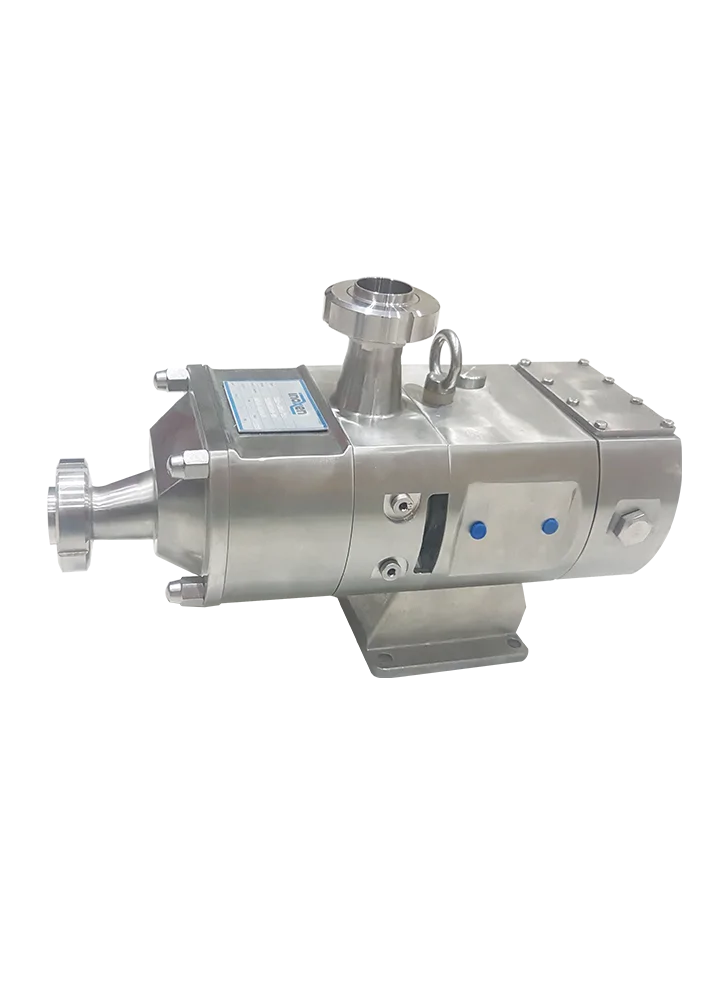
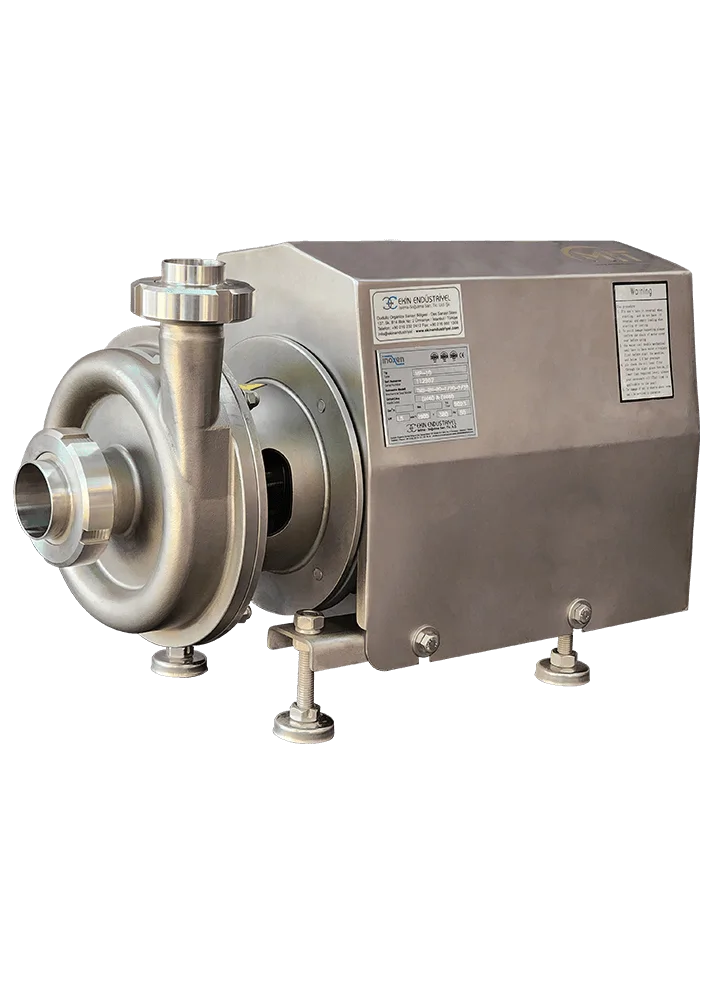
Twin-screw pumps and hygienic centrifugal pumps perform fluid transfer through completely different mechanisms. Therefore, they show significant distinctions in terms of process behavior, performance curves, pressure-flow relationships, and applicable fluid types. Understanding the operating principles correctly is critical for determining which pump is suitable for which process conditions.
Hygienic centrifugal pumps are dynamic pumps that operate on the principle of centrifugal force. The high-speed rotation of the pump fan gains speed between the fluid fan blades, and the increase in kinetic energy converts to pressure at the pump outlet, enabling the flow. This design is highly efficient in processes where the flow rate requirement is high and the fluid is of low viscosity. However, the flow rate of centrifugal pumps is pressure-dependent; that is, as system resistance increases, the flow rate decreases. Additionally, an increase in viscosity causes a loss of fluidity between the fan blades, significantly reducing performance. Therefore, centrifugal pumps are preferred in low viscosity applications such as heat transfer, milk and beverage transfer, clean water, and chemical solutions.
Twin-screw pumps operate on the principle of positive displacement. Two screws rotating in opposite directions inside the pump trap the fluid between the gears and transport it from the inlet to the outlet. This mechanism ensures a constant volume is transferred with each rotation. Therefore, the flow rate of twin-screw pumps is independent of changes in system pressure, and process conditions remain stable. An increase in viscosity can enhance performance instead of reducing it; because the leakage flow of the fluid decreases, and volumetric efficiency increases. This feature is a significant advantage over centrifugal pumps. Additionally, since there is no contact between the rotors, wear is minimal, providing pulsation-free and vibration-free flow, preserving particle integrity, and ensuring high hygiene.
Another important difference arises in the management of gas-liquid mixtures. Centrifugal pumps may lose efficiency or develop air locks in fluids containing gas. In contrast, twin-screw pumps can easily transfer such mixtures and even facilitate initial suction conditions thanks to their self-priming capability.
As a result, the operating principles distinctly differentiate the usage areas of both pump types. Hygienic centrifugal pumps offer superior performance in applications requiring low viscosity and high flow rates, while twin-screw pumps are the ideal solution in processes where high viscosity, high pressure, and pulsation-free flow are critical. These fundamental differences are decisive for industrial enterprises in making the right pump selection according to their process needs.
Suitability for Fluid Types and Viscosity Performance
The success of a pump in industrial processes depends not only on its mechanical design but also on how efficiently it can transfer different types of fluids. One of the most significant differences between twin-screw pumps and hygienic centrifugal pumps is their response to viscosity and fluid behavior. These differences are fundamental criteria that directly affect businesses' pump selection.
Hygienic centrifugal pumps are optimized for low and medium viscosity fluids. As the fluid's viscosity value increases, the performance of the centrifugal pump decreases; because flow losses increase between the fan blades, and the fluid cannot achieve sufficient acceleration. Therefore, fluids such as milk, fruit juice, beverages, chemical solutions, light oils, and similar fluids can be successfully transported with centrifugal pumps. However, products with a honey-like, molasses-like consistency, mixtures with high oil content, or fluids containing high particles are not suitable for centrifugal pumps. An increase in viscosity can lead to excessive loading on the pump motor and significant decreases in flow rate.
Coaxial twin-screw pumps are positive displacement equipment designed to manage a very wide viscosity range. They can operate with the same stability across a wide spectrum, from low-viscosity fluids to extremely dense products. The rotors carry the fluid in fixed volumes while rotating, preventing the increase in viscosity from reducing performance; in fact, as leakage flow decreases at high viscosity, the volumetric efficiency of the pump increases. Therefore, challenging fluids such as dense food products, yogurt, cream, chocolate derivatives, syrup, paste, chemical polymers, and high-viscosity oils can be safely transported with twin-screw pumps.
The particle structure contained in the fluid is also a determining factor in pump selection. Centrifugal pumps should generally be used for particle-free fluids; because the high-speed rotating impeller causes particles to collide with the blades, increasing wear and potentially damaging hygienic surfaces. Twin-screw pumps, on the other hand, can transport larger particles without disrupting the integrity of the fluid thanks to their non-pulsating operation principle. This feature provides a significant advantage in applications where fruit-pulp products, sauces, grain-containing mixtures, and particle degradation affect process quality.
As a result, when evaluated in terms of viscosity, particle structure, and fluid characteristics, twin-screw pumps offer a much wider range of applications, while hygienic centrifugal pumps excel in transporting low-viscosity and clean fluids at high flow rates. These differences play a critical role in selecting the right pump technology according to process requirements.
Pressure Capacity and Flow Stability
In pump selection, pressure capacity and flow stability are among the most important technical parameters that directly affect the performance of the process. Since both types of pumps have different pressure-flow relationships, businesses must analyze their process requirements accurately to make a selection.
Hygienic centrifugal pumps, being part of the dynamic pump class, have a flow production capacity that largely depends on system pressure. In other words, an increase in system resistance causes a decrease in flow. This characteristic can lead to performance fluctuations in long pipelines, applications requiring high pressure, or processes where viscosity is variable. Centrifugal pumps generally yield ideal results in low-pressure, high-flow transfers. Although they can provide discharge heights of up to 70 meters, as pressure increases, the flow curve rapidly declines. Therefore, in applications requiring high pressure, centrifugal pumps may be limited in maintaining process stability.
In contrast, twin-screw pumps provide a constant flow largely independent of system pressure due to their positive displacement operating principle. Since the volume carried with each rotor revolution is constant, increases in system pressure do not lead to a decrease in flow. This feature provides a significant advantage in processes that require stable flow even under high pressure. Twin-screw pumps can operate safely up to 20 bar levels and maintain flow stability even under high pressure. This situation particularly enhances process reliability in fluids with variable viscosity, long transfer lines, dosing applications, and sensitive products.
Pressure and flow stability are also critically important for protecting the structural integrity of the fluid. Centrifugal pumps dynamically accelerate the fluid due to the high-speed rotating impellers, which can create unwanted turbulence in products requiring non-pulsating flow. Twin-screw pumps, however, offer low-pulsation, vibration-free, and continuous flow, preventing damage to the product during flow.
From a process engineering perspective, while centrifugal pumps provide an economical and efficient solution in high-volume flows, twin-screw pumps deliver superior performance in applications requiring high pressure, variable viscosity fluids, and critical flow stability. Therefore, when analyzed in terms of pressure and flow stability, the nature of process requirements is the key factor determining which pump is the correct choice.
Particle Permeability and Non-Pulsating Flow Feature
Transporting fluids containing particles is a subject that requires special design in terms of both product integrity and process reliability. The transport of solid particles within the fluid without damage, crushing, or structural form degradation directly affects quality standards, especially in the food, beverage, and cosmetic industries. Therefore, the particle permeability of pumps and the management of flow in a non-pulsating manner are among the decisive factors in pump selection.
Hygienic centrifugal pumps are limited in their suitability for particle transport due to their high-speed rotating impeller structures. The contact between the impeller and particles can lead to wear within the pump and degradation of the product's physical integrity. Particles striking the fan blades can break, crush, or structurally fragment. Additionally, impacts occurring on the impeller can disrupt the balance of the pump, increasing vibration and noise levels. This makes centrifugal pumps an unsuitable option, especially for fruit-pulp beverages, vegetable purees, sauces, viscous products containing particles, or solid-content chemical mixtures.
In contrast, twin-screw pumps demonstrate high success in transporting particulate fluids due to their positive displacement designs that produce non-pulsating and low-pulsation flow. Since the rotors carry the fluid in fixed volumes, the fluid and the particles within it are gently pumped. As the rotors do not touch each other, the fluid is not compressed, allowing particles to pass without being crushed. Models with a large screw gap can easily transfer larger particles, while models with a small screw gap cater to applications requiring higher pressure.
This non-pulsating flow structure is preferred in many industries where product quality must be preserved. For example, sensitive food products such as fruit-based yogurts, pulpy fruit purees, chocolate chip cream products, nut butters, or grain-based beverages can be transported without altering their form. Similarly, in the cosmetic industry, pulpy peeling products, in the chemical industry, solutions containing crystals, and in the pharmaceutical industry, granular mixtures can be safely managed with twin-screw pumps.
Non-pulsating flow provides advantages not only in terms of product quality but also in terms of process safety. Pulsation-free flow prevents the formation of vibrations, fluctuations, and pressure shocks in the pipeline. This situation both extends equipment life and reduces the risk of damaging other sensitive components in the system.
As a result, twin-screw pumps offer a much wider range of applications in terms of particle permeability, while hygienic centrifugal pumps can only perform in particle-free or minimum particle-containing fluids. In processes where non-pulsating and precise flow is required, twin-screw pumps are clearly the most ideal option.
Hygienic Design, CIP and SIP Compliance
Hygiene requirements are one of the most critical criteria determining pump selection in industries such as food, beverage, pharmaceuticals, cosmetics, and biotechnology. Equipment used in these areas must be easy to clean, have surfaces where bacteria cannot adhere, and be resistant to chemical and thermal cleaning processes. Therefore, the performance of twin-screw pumps and hygienic centrifugal pumps in CIP (Clean-in-Place) and SIP (Sterilize-in-Place) applications directly influences users' pump preferences.
Hygienic centrifugal pumps are generally made of 316L stainless steel and are designed to meet hygiene standards regarding surface roughness. By optimizing the cover and fan geometries, the aim is to reduce blind spots, prevent bacterial adhesion, and increase cleaning efficiency. However, due to static areas and regions within the volume where flow does not fully circulate, centrifugal pumps may have limited CIP performance. Additional CIP pumps and valve systems may be required during the process for cleaning operations to be effective. Although they can support short-term SIP operations at high temperatures, their durability against continuous high-temperature applications may be limited.
Twin-screw pumps stand out with their dual-purpose structures that can operate for both product transfer and CIP processes. The rotor design and body structure of these pumps allow both viscous products and cleaning chemicals to circulate completely within the system with non-pulsating flow. Thus, cleaning operations can be carried out in the process line without the need for a separate CIP pump. This feature reduces the number of equipment in the system, decreases piping and valve requirements, and optimizes investment costs.
Additionally, the blind-spot-free design of twin-screw pumps ensures that the flow progresses homogeneously across all internal surfaces. Since there is no contact between the screw and the body, product accumulation does not occur, and the cleaning process is completed in a short time. Their structure, which is resistant to high temperatures in SIP applications, allows sterilization processes to be carried out safely. All surface roughness and material standards required by hygienic design can also be fully met in this type of pump.
As a result, when evaluated in terms of hygienic design, centrifugal pumps provide a successful solution in standard hygienic processes, while twin-screw pumps combine both product transfer and CIP/SIP functions in a single device, providing much higher hygiene efficiency and operational advantages. Therefore, in facilities where cleaning processes are critical, twin-screw pumps emerge as the most suitable option, reducing long-term costs and increasing process reliability.
Energy Efficiency and Its Impact on Operating Costs
Pump selection directly affects not only technical performance but also long-term energy consumption and operating costs. Due to their different operating principles, twin-screw pumps and hygienic centrifugal pumps have significant differences in terms of energy efficiency and total cost of ownership. Proper assessment of these differences contributes to businesses' sustainability goals and cost optimization strategies.
Hygienic centrifugal pumps operate quite efficiently in applications where low-viscosity fluids are transferred at high flow rates. These pumps, which transfer kinetic energy to the fluid thanks to their fan structure, can keep energy consumption at a minimum level in processes requiring low pressure. However, in cases of high viscosity, long pipelines, high lifting heights, or increased system resistance, energy consumption rises rapidly. This is because the motor starts consuming more power to accelerate the fluid in the screw. Therefore, centrifugal pumps operate more energy-efficiently the lower the process conditions are in terms of resistance and viscosity.
Twin-screw pumps provide a constant flow regardless of pressure and viscosity due to their positive displacement structure. This results in predictability in energy consumption, as the power consumed by the pump is largely related to the volume being transferred. In processes requiring high viscosity and high pressure, energy consumption is kept under control, unlike centrifugal pumps. Additionally, since non-pulsating flow and low pulsation reduce losses in the pipeline, the pump operates with lower stress. This feature increases operational efficiency and reduces energy consumption.
Energy efficiency is not limited to motor consumption; additional equipment required in process design should also be included in the total energy cost. Systems using centrifugal pumps typically require a separate CIP pump, control valves, and flow directing equipment. Each piece of equipment increases both energy consumption and maintenance costs. However, twin-screw pumps reduce the number of equipment in the system since they can manage both product transfer and CIP processes with a single device. This situation lowers both initial investment costs and optimizes energy costs throughout the operation period.
However, process downtime durations are also an important parameter in cost accounting. The low wear tendency of twin-screw pumps provides longer maintenance intervals and less component replacement. Since centrifugal pumps operate at higher speeds, they may require more frequent maintenance in some processes. This difference creates an indirect cost advantage that affects the long-term energy and operating budget.
As a result, when evaluated in terms of energy efficiency, centrifugal pumps offer an economical solution in low viscosity, low pressure applications, while twin-screw pumps provide significant advantages in total cost of ownership with stable energy consumption, low additional equipment needs, and long maintenance intervals in more challenging processes. Therefore, when selecting a pump, it is necessary to evaluate not only the initial purchase cost but also all operational expenses comprehensively.
Ease of Maintenance, Spare Parts, and Service Requirements
One of the factors determining the impact of pump technologies on operational efficiency is maintenance requirements and service ease. Maintenance durations, spare parts needs, and service intervals directly affect the downtime of the production line, total operating costs, and the long-term performance of the equipment. Therefore, the maintenance characteristics of twin-screw pumps and hygienic centrifugal pumps should be evaluated in detail during the pump selection process.
Hygienic centrifugal pumps are equipment that requires regular maintenance due to their high-speed operation and mechanical seal systems. Shaft-balance problems, seal surface wear, bearing failures, and friction marks that may occur on the internal surfaces of the body are the most common elements in maintenance cycles. Especially in pumps exposed to high temperatures, high speeds, and cleaning chemicals, the seal life may be shorter. Therefore, centrifugal pumps should be disassembled and cleaned at regular intervals, and critical parts should be checked. Although spare part availability is high, the need for frequent replacements can increase operating costs.
On the other hand, twin-screw pumps offer longer maintenance intervals due to their low wear tendency designs. Since the rotors do not contact each other, wear is at a minimum level, and since there are no bearings in contact with the product in the internal structure of twin-screw pumps, the risk of accumulation, wear, or damage in these areas is eliminated. Large diameter 17-4PH shafts, heavy-duty bearings, and threaded locking nuts enhance the mechanical durability of the pump. This design reduces maintenance needs while extending the service life of the pump. The ease of disassembly and reassembly of the pump minimizes downtime in production lines, providing quick cleaning and short maintenance durations.
In terms of spare parts, the advantage of twin-screw pumps is that the components are highly durable and have a structure that needs to be replaced less frequently. Especially the option of adding single or double seals later makes it easier to adapt the system to the needs. In contrast, centrifugal pump seals must be replaced more frequently due to high speed and friction.
There are also significant differences between the two pump types in terms of service requirements. Centrifugal pumps require more precise adjustments due to their high-speed mechanical structures, while twin-screw pumps operate at low speeds and high torque, requiring less fine-tuning during service. The ability to operate bidirectionally without changing the piping arrangement simplifies service operations.
As a result, when evaluated in terms of ease of maintenance, twin-screw pumps provide significant advantages to businesses with longer service intervals, low wear levels, and easily disassembled and reassembled structures. Hygienic centrifugal pumps, on the other hand, are systems that require higher maintenance needs, frequent seal replacements, and balance checks. Therefore, if businesses want to reduce total ownership costs and increase production continuity, they should consider maintenance requirements as one of the key decision criteria.
Flexible Applications and Sectoral Uses
Evaluating the performance of pump technologies in different sectors is critical for determining which pump will be the right choice under which operating conditions. Twin-screw pumps and hygienic centrifugal pumps are developed according to different process requirements and show distinct differences in their applications across sectors. These differences allow businesses to select pump technologies that meet the specific requirements of their processes.
Hygienic centrifugal pumps are commonly used in sectors that require the high flow and rapid transfer of low viscosity fluids. In the food and beverage industry, they are preferred as a standard solution for transporting clean and fluid products such as milk, water, fruit juice, beer, and wine. They also provide high efficiency in the transfer of solutions, solvents, and low-density chemicals in the pharmaceutical and chemical industries. In sectors such as HVAC, metal processing, and automotive, they are used in the circulation of cooling water, process fluids, and clean liquids. The compact design and high flow capacity of these pumps provide a significant advantage when continuous and high-volume flow is required.
Twin-screw pumps, on the other hand, are advanced positive displacement pumps that can adapt to a much wider range of fluids, providing smooth and stable flow even in high viscosity products. They excel in transporting sensitive products such as yogurt, cream, chocolate, honey, jam, peanut butter, particulate mixtures, and high viscosity filling materials without altering their form in the food industry. They also maintain their performance in gas-liquid mixtures and foamy products. In the pharmaceutical, cosmetic, and chemical industries, they are ideal solutions for gels, pastes, polymers, emulsions, and thixotropic fluids that require high precision.
In industrial fields, twin-screw pumps offer wide application flexibility. They provide reliable performance in transporting viscous oils, lubricants, and reactive fluids in petrochemical processes. In the energy sector, they stand out for their durability in chemical circulation lines of heating and cooling systems and in high-temperature applications. In sectors with heavy process loads such as metal industry, maritime, and textiles, they are preferred for their resistance to high pressure and stable flow. Additionally, their ability to operate bidirectionally simplifies system design and enables the transfer of fluids in both directions.
When compared across sectors, hygienic centrifugal pumps serve as a standard solution in processes where clean fluid transfer is intense; twin-screw pumps demonstrate superior performance in challenging applications where high viscosity, particle sensitivity, hygiene requirements, and high pressure needs converge. Therefore, businesses should determine the most suitable pump type based on product structure, process requirements, and long-term cost objectives.